Kevin Warsh's nomination as Federal Reserve chair could mark a historic turning point. Not merely because it would represent a return to an institution he previously served as governor between 2006 and 2011, but because financial disclosure documents reveal personal crypto-asset exposure exceeding $100 million. For the first time, the world's most influential central bank could be led by someone with a material position in Bitcoin and digital assets.
This situation raises major strategic questions. How can such personal exposure be reconciled with the independence required to steer Fed policy? What are the implications for institutional adoption of crypto-assets? And crucially, how might this appointment reshape the delicate balance between financial innovation and macroeconomic stability?
An atypical profile for a strategic role
Kevin Warsh is no stranger to the Fed. During his tenure as governor, he led crisis management following the 2008 financial collapse, notably overseeing emergency liquidity programs. His time at the Fed was characterized by a pragmatic approach to monetary policy, often critical of the central bank's prolonged balance sheet expansion.
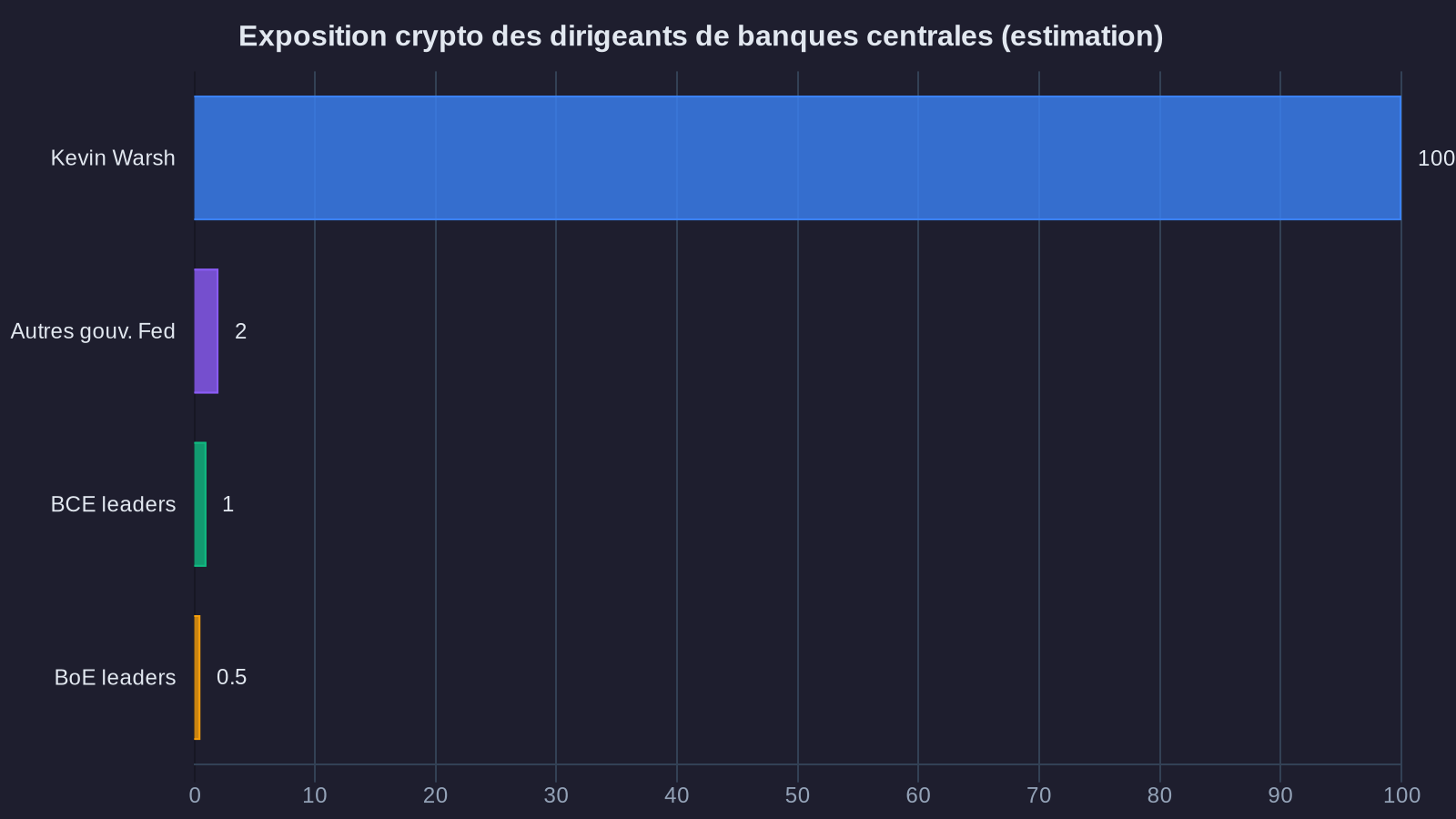
What has changed radically today is his positioning on crypto-assets. Financial disclosure documents reveal diversified exposure including direct positions in Bitcoin, as well as investments in blockchain infrastructure funds and vehicles with sector exposure. This allocation represents a significant portion of his total wealth, estimated between $40 and $50 million according to latest public disclosures.
There's an interesting paradox here. Warsh has historically advocated for restrictive monetary policy, repeatedly criticizing the massive quantitative easing of the post-2008 era. Yet simultaneously, he has accumulated substantial Bitcoin exposure, an asset whose appreciation has greatly benefited from that same monetary expansion he contested. This apparent contradiction warrants closer examination.
Implications for US monetary policy
Warsh's personal position in crypto-assets introduces a new dimension to the Fed independence debate. Unlike traditional conflicts of interest tied to stock or bond holdings, crypto-asset exposure raises more complex questions. Bitcoin and digital assets operate in an ecosystem where Fed policy decisions have direct impact, yet transmission mechanisms remain poorly understood.
Take a concrete example. If the Fed decides to cut rates while its chair holds a material Bitcoin position, how will the market interpret this decision? Is it an appropriate response to macroeconomic conditions, or policy influenced by personal wealth considerations? The question alone creates reputational risk for the institution.
This situation could lead to two opposing scenarios. The first, optimistic for the crypto ecosystem, would see Warsh adopt a more nuanced approach to digital asset regulation, recognizing their legitimacy as an asset class while establishing appropriate prudential frameworks. The second, more defensive, could push him toward an excessively strict stance to avoid any favoritism accusations.
The digital dollar question
One of the most sensitive issues the next Fed chair will face concerns potential development of a digital dollar. Warsh's public positions on this subject have been relatively cautious, emphasizing risks to the commercial banking system and privacy concerns. But his personal crypto exposure could shift his risk-benefit analysis.
An investor holding a material Bitcoin position could theoretically view US central bank digital currency deployment unfavorably, seeing it as direct competition. Conversely, this same exposure could make him more receptive to technical arguments and innovations from the blockchain ecosystem, potentially enabling a more sophisticated approach to the topic.
The shockwave on institutional adoption
Beyond Bitcoin monetary policy stricto sensu, Warsh's appointment would send a powerful signal to institutional investors. The implicit validation represented by a significant crypto-asset holder leading the Fed could accelerate institutional adoption by major portfolios.
A marked trend is already evident since 2023. US pension funds, traditionally conservative, are beginning to integrate crypto exposures into alternative allocations. The Wisconsin Teachers Retirement Fund, for example, disclosed a position in Bitcoin ETFs. Warsh's appointment could transform this cautious movement into genuine momentum, as demonstrated by enthusiasm for institutional stablecoins.
The implications extend beyond simple valuation. Accelerated institutional adoption structurally modifies the liquidity and volatility profile of crypto-assets. Flows become more predictable, investment horizons lengthen, and price discovery mechanisms improve in efficiency. This is precisely the market maturation that professional investors seeking uncorrelated returns find compelling.
Governance and transparency considerations
The question of managing potential conflicts of interest cannot be avoided. Fed chairs are subject to strict rules regarding personal investments, including mandatory holding periods and restrictions on transactions during their tenure. But these rules were designed for traditional assets with relatively predictable valuation cycles.
Crypto-assets introduce additional complexity. Their extreme volatility means a position's value can swing 50% in weeks, creating situations where personal wealth fluctuations could theoretically influence institutional decisions. The Fed will likely need to adapt its governance framework to account for these specificities.
One solution might involve complete divestment of crypto positions, similar to requirements for certain individual stocks. But this approach poses its own questions: forcing the sale of a $100 million position in a relatively narrow market could create significant price distortions. The alternative, holding the position in a blind trust, offers limited assurance given the now-established correlation between monetary policy and crypto valuation.
Toward a new monetary normal?
Warsh's potential appointment is part of a broader transformation of the monetary and financial landscape. Central banks worldwide are reassessing their relationship with digital assets, gradually shifting from outright rejection toward more pragmatic approaches to regulated coexistence.
The European Central Bank recently published a report acknowledging stablecoins' potential role in payment infrastructure. The Bank of England is experimenting with blockchain settlement mechanisms for government securities. Even the Bank for International Settlements, traditionally conservative, is multiplying pilot projects exploring distributed ledger technology applications.
In this context, a Fed chair personally invested in the crypto ecosystem could accelerate digital asset integration into the traditional financial system. Not from ideology, but from deep understanding of the mechanisms at play and the opportunities they represent for market efficiency, as evidenced by Coinbase-Fannie Mae's mortgage lending experimentation.
Risks obviously exist. Integration too rapid without adequate prudential frameworks could create systemic vulnerabilities. Growing interconnection between traditional finance and crypto-assets means shocks now propagate both directions. FTX's collapse demonstrated how a crypto actor's failure can contaminate regulated financial institutions carrying poorly-calibrated exposures.
The political equation
It would be naive to ignore this appointment's political dimension. The current US administration has shown a relatively favorable approach to crypto-assets, contrasting with the more restrictive posture of the previous era. Naming a Fed chair who personally holds crypto positions sends a clear signal about strategic priorities.
This political dimension carries its own risks. Should crypto-assets experience sharp correction during Warsh's tenure, political opposition will be quick to point fingers at perceived conflicts of interest. Conversely, exceptional performance could raise questions about monetary policy decisions potentially favoring this appreciation, particularly within the framework of the new SEC-CFTC regulatory framework.
Kevin Warsh's appointment to lead the Federal Reserve represents far more than a simple leadership change. It potentially marks crypto-assets' entry into the sphere of institutional monetary policy, with all the opportunities and risks that entails. For institutional investors building return strategies on digital assets, this shift fundamentally alters the risk-return equation. The implicit validation such an appointment provides could catalyze institutional adoption, but it comes with heightened governance and transparency requirements. The next decade may well see crypto-assets transition from speculative alternative status to standard component of institutional portfolios, overseen by a central bank led by one of their most significant holders.
```