
In October 2023, the European Central Bank published a report that made waves in the crypto ecosystem. Its message was clear: most of the protocols people call "decentralized" are not really. This assertion isn't just a philosophical debate among blockchain purists. With the Markets in Crypto-Assets regulation (MiCA) coming into force in 2024, this question of genuine decentralization becomes a major legal issue for anyone investing in decentralized finance.
Imagine you're attending a shareholders' meeting. On paper, each share gives you one vote. In reality, three people own 80% of the shares and decide everything. Is the meeting really democratic? This is exactly the problem the ECB raises with DAOs (decentralized autonomous organizations) that govern DeFi protocols.
What the ECB actually said about DAO governance
The ECB report doesn't criticize blockchain technology itself. It highlights a gap between the narrative and operational reality. According to the analysis of European regulators, the majority of DeFi protocols exhibit significant centralization points, whether in their governance, technical infrastructure, or development.
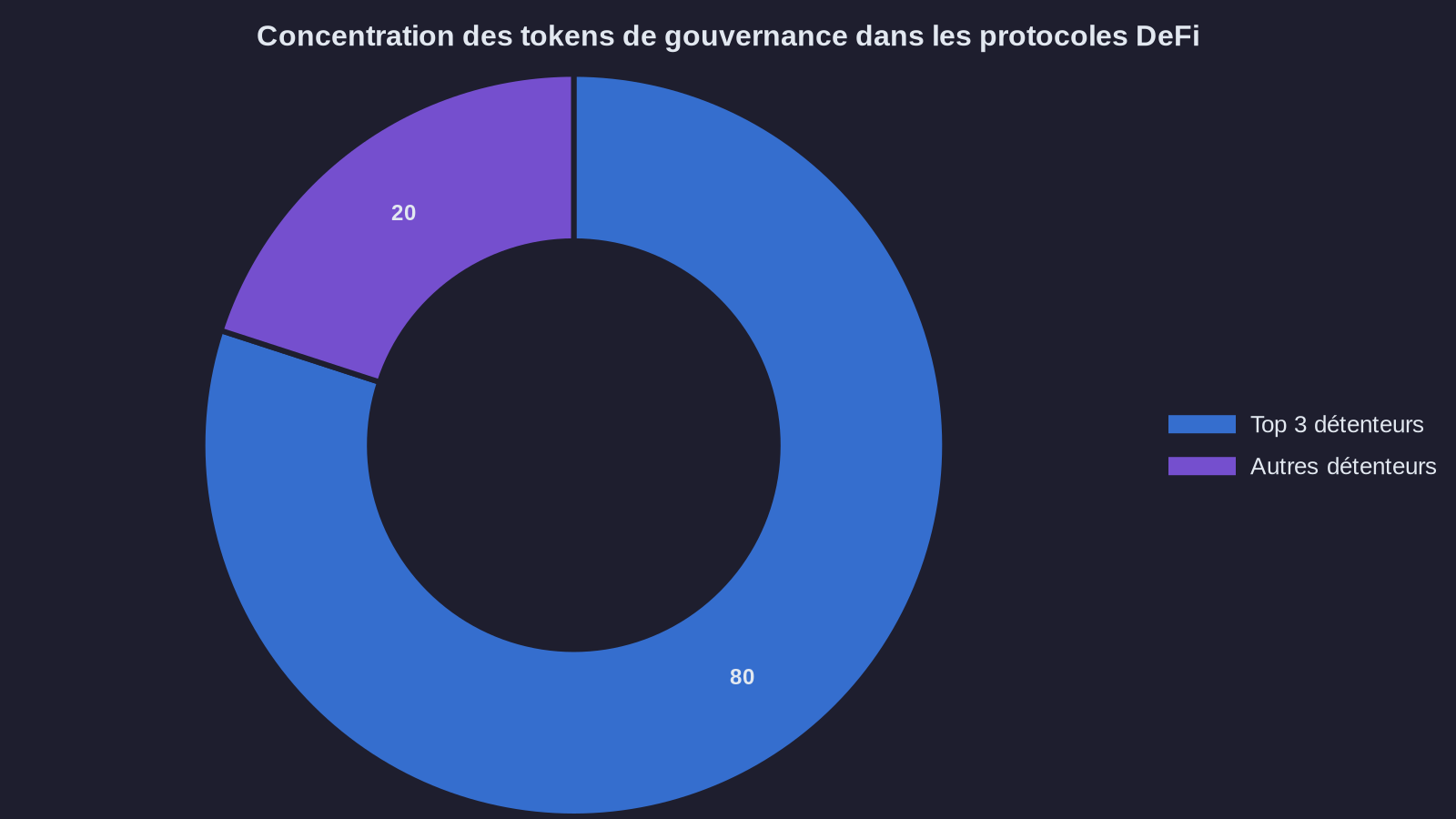
Specifically, the ECB observes that governance tokens are often concentrated in a few hands. A study cited in the report shows that on certain major protocols, less than 1% of token holders control more than 90% of voting power. This concentrated DeFi risk is comparable to a company claiming to be a cooperative while three founders keep absolute majority ownership.
The second centralization point identified concerns multisig wallets. These multi-signature wallets, supposed to secure the protocol's funds, are often controlled by a handful of known individuals, sometimes the founders themselves. If these people jointly decide to modify the protocol's rules or access the funds, they can. Decentralization becomes a technical facade rather than governance reality.
Why DeFi compliance with MiCA changes the game for investors
The MiCA regulation establishes a regulatory framework for all crypto assets in Europe. Its founding principle is straightforward: if you offer a financial service to the European public, you must comply with certain rules on transparency, consumer protection, and anti-money laundering. No exceptions.
Except one. MiCA provides an exemption for "truly decentralized" protocols. This deliberately vague notion in the text now becomes the heart of the debate. If a protocol isn't genuinely decentralized in the way regulators understand it, it falls under MiCA and must comply with all applicable regulations for digital asset service providers.
For you investing in DeFi, this distinction has immediate practical consequences. A protocol required to comply with MiCA will likely need to implement KYC (Know Your Customer) procedures, restrict access to certain users based on their jurisdiction, and meet reporting obligations. Some protocols might simply choose to block access to European users rather than enter a costly and complex compliance process.
It's already happened. Several DeFi platforms restricted access to European IP addresses as soon as MiCA was announced, preferring to lose this market rather than undertake an expensive and complicated compliance journey.
Criteria for "genuine" decentralization according to Europe's DeFi regulation
So what makes a protocol truly decentralized in MiCA's eyes? The regulation doesn't provide a precise framework, but national authorities are beginning to publish their interpretations. The AMF (French Financial Markets Authority) and Germany's BaFin converge on several key points.
First, the distribution of governance tokens. A protocol where 10 people hold 51% of votes isn't decentralized, even if technically anyone can buy tokens. Regulators look at actual distribution, not theoretical. They also examine mechanisms like vesting that guarantee founders can't dump their tokens and lose all interest in the project overnight.
Next, technical autonomy. An immutable smart contract on a public blockchain is a good start. But if that contract can be updated by an identified team, you fall back into a form of centralization. Regulators want to know who holds the update keys, how modification decisions are made, and whether the community has genuine blocking power.
Finally, the legal entity question. Many DeFi protocols are developed by real foundations or companies, with employees, offices, and accounting. The existence of this structure isn't inherently a problem, but it becomes a centralization point if that entity retains operational control over the protocol once it's launched.
What blockchain compliance changes for your DeFi strategy
If you invest in DeFi, this regulatory shift requires you to ask new questions before allocating funds to a protocol. First: is this protocol genuinely decentralized in MiCA's sense, or does it risk having to comply in coming months?
This isn't just an administrative question. It directly impacts risk and returns. A protocol forced to implement KYC procedures will likely see its liquidity drop, affecting returns. Conversely, a truly decentralized protocol keeps its competitive edge: no barriers to entry and no compliance costs. To dive deeper into the issues of passive income from crypto assets, understanding these compliance dynamics becomes essential.
A few warning signals to watch for. If the protocol's website is hosted by an identifiable company, if social media is managed by a marketing team, if code updates are pushed by a restricted group of salaried developers, you're probably not dealing with genuine decentralization. This isn't necessarily a deal-breaker, but it means the protocol will likely need to evolve or comply.
The second strategic question concerns geolocation. Some protocols chose to voluntarily comply with MiCA to maintain access to the European market. This approach has costs, but it also offers a form of legitimacy and longevity. Others bet on maximum decentralization to stay outside the regulatory perimeter. Both strategies are valid, but they involve different risk profiles.
For an institutional investor or family office subject to fiduciary duties, working with a MiCA-compliant protocol may become a prerequisite. The trend toward institutionalization, notably visible with BlackRock's ETHB ETF, illustrates this evolution. For an individual investor seeking the best returns without geographic constraints, non-compliant protocols remain accessible via VPNs, though this practice raises jurisdiction-specific legal questions.
The future of DeFi in Europe: adaptation or avoidance?
The ECB's position on DAO centralization opens a fundamental debate about the future of decentralized finance in Europe. Two scenarios are emerging. In the first, major DeFi protocols gradually accept a certain level of regulatory compliance, even if it means losing some of their decentralist ethos. They become regulated, stable, predictable actors, but less disruptive.
In the second scenario, a new generation of radically decentralized protocols emerges, designed from the outset to be technically and legally beyond regulators' reach. These protocols will have no foundation, no identifiable team, no centralized website. Their governance will be genuinely distributed, even if it means lower operational efficiency.
Both models will likely coexist. Some users will prioritize legal certainty and compliance. Others will seek maximum freedom of action, willing to navigate a regulatory gray zone. The European market, with its 450 million consumers and now-clarified legal framework, will become a real-world test to see if DeFi can thrive under regulation.
One thing is certain: the era when you could launch a DeFi protocol without worrying about its governance structure and claim decentralization simply by invoking blockchain is over. MiCA forces the ecosystem toward maturity. Protocols will have to choose their position and accept the consequences.
For you investing in this ecosystem, this clarification is ultimately good news. It lets you distinguish serious projects that have thought through their DAO governance and MiCA compliance from opportunistic projects that use decentralization terminology without respecting its substance. In a young and volatile market, this capacity for discernment becomes a real competitive advantage.