
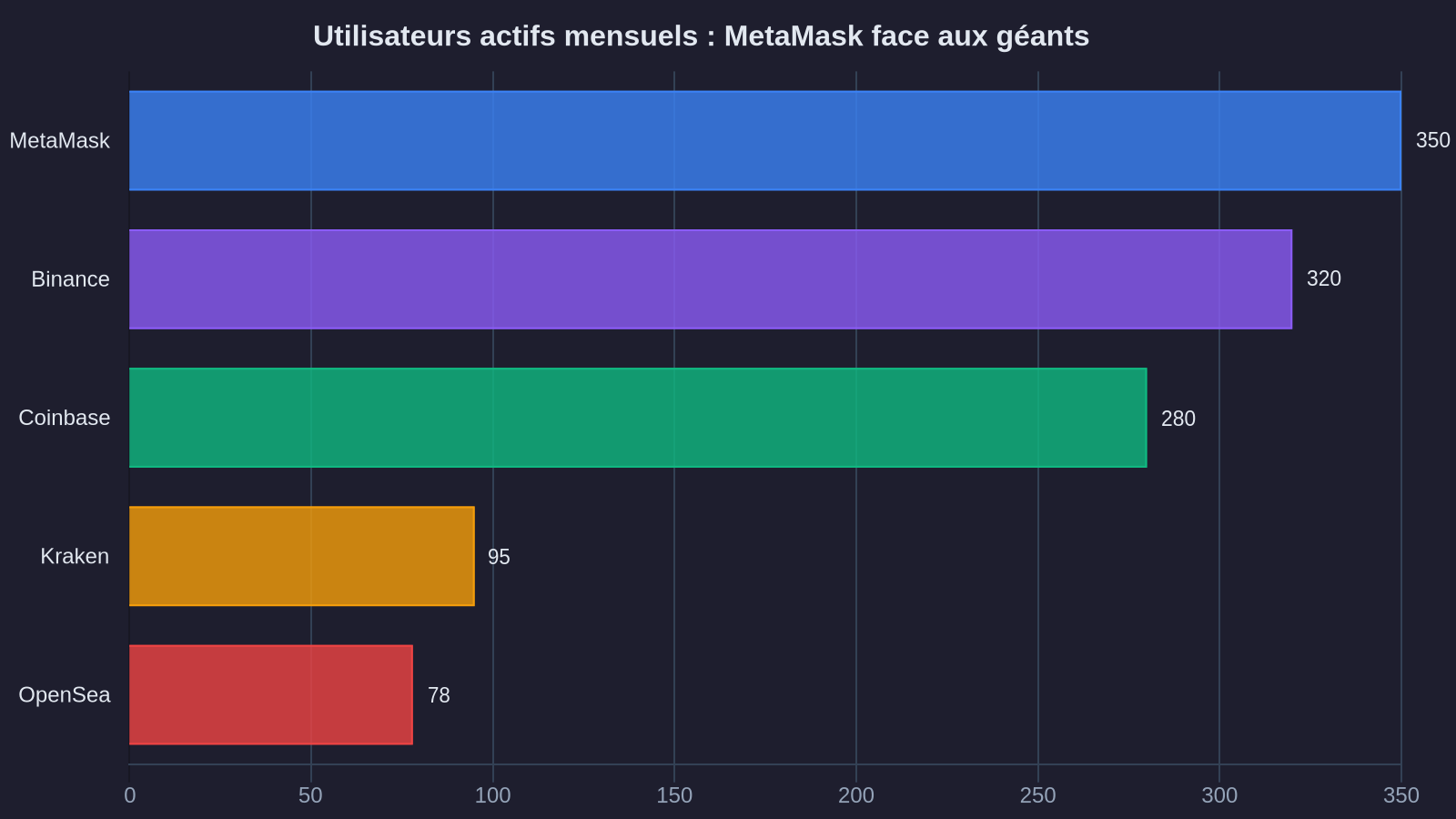
MetaMask hit 350 million monthly active users on March 18, 2026. That's more than Binance, more than Coinbase. Yet until now, this ubiquitous wallet remained a simple division of Consensys, the parent company founded by Joseph Lubin. That's about to change with the announcement of the spin-off and the MetaMask IPO scheduled for 2027.
The announcement of this independence from Consensys reshuffles the Ethereum ecosystem deck. For the first time, MetaMask will operate as an independent entity with its own governance, its own stated business model, and most importantly: a public market valuation. What was a tool becomes a public company. What was infrastructure becomes an investable asset.
Several questions immediately emerge: why now? What does this separation concretely change for users and developers? And most importantly, how do you position your portfolio in the face of this structural transition?
Consensys restructuring: a separation that follows clear economic logic
Consensys has long carried MetaMask as a strategic product without aggressive monetization. The playbook: capture the audience, become the reference interface for Ethereum, then monetize through ancillary services (swap, bridge, staking). It worked. Too well, even.
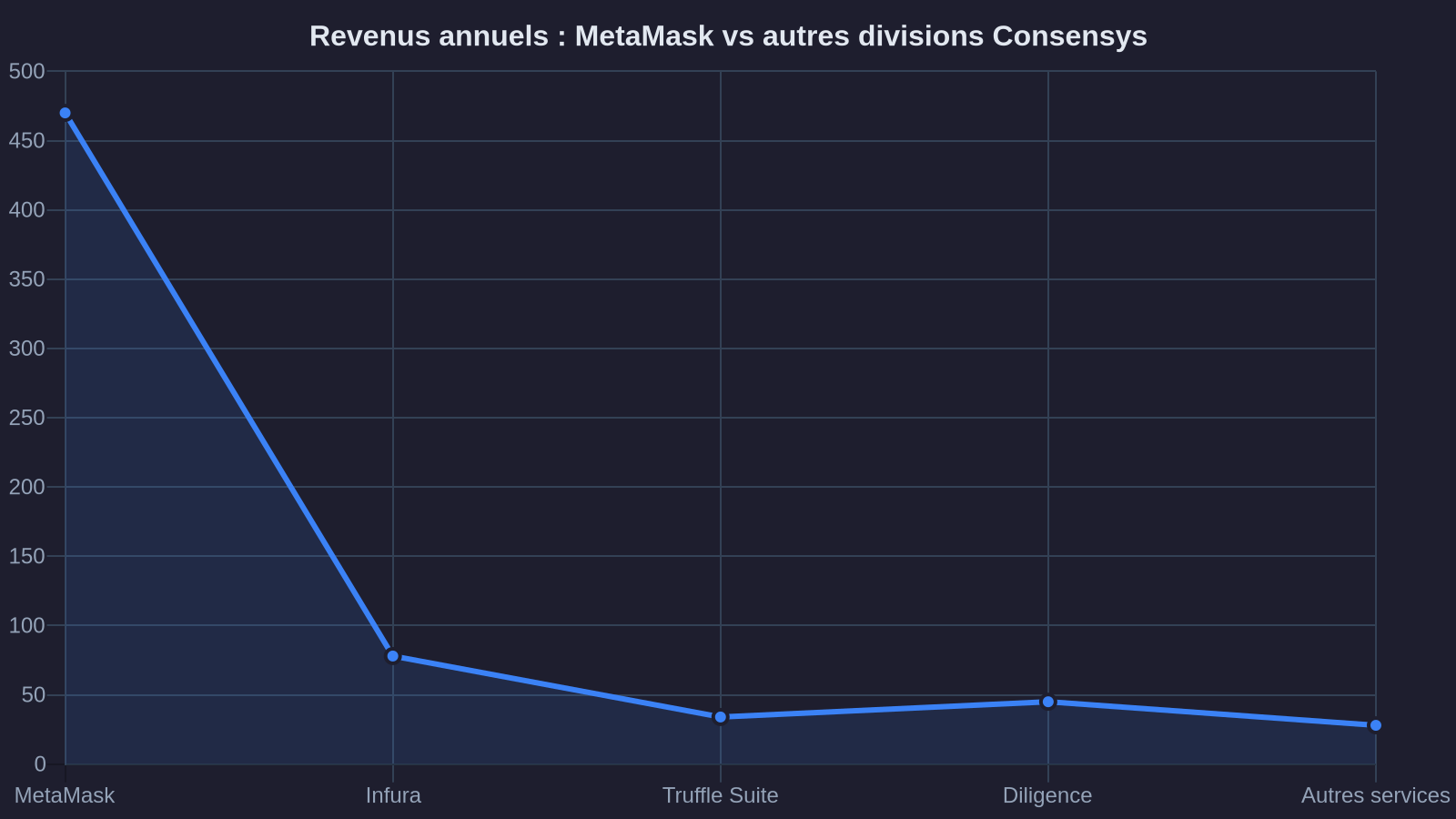
The problem is that MetaMask now generates more revenue than all of Consensys's other activities combined. Q4 2025 public figures show $470 million in annual revenue for the MetaMask division, versus $190 million for Infura and infrastructure services. When one division accounts for 71% of consolidated revenue, the separation question becomes legitimate.
Consensys faces mounting pressure from its historical investors — Microsoft, JPMorgan, Mastercard through their venture funds — who want liquidity. But a Consensys IPO as a whole presents a problem: how do you value a holding that mixes B2B technical infrastructure and consumer-facing applications? Valuation multiples aren't comparable—a situation we've seen in other restructurings in the crypto sector.
The spin-off solves this equation. MetaMask goes public with a clear narrative: world leader in non-custodial wallets, 350 million users, business model based on swap commissions (0.875% average) and in-app advertising revenue. Consensys remains private and continues developing its B2B offerings without the pressure of public markets.
What concretely changes for users and developers
In the short term: nothing. The interface stays the same, private keys stay where they are, dApp integrations work as before. MetaMask has already clarified that the legal and operational transition will happen progressively between Q2 2026 and Q1 2027, without service interruption.
In the medium term, three structural shifts are emerging. First, an acceleration in product development. Independent MetaMask will have its own R&D budgets, without arbitration against Consensys's other projects. We can expect a step up in advanced features: improved multi-chain management, native DeFi protocol integration, built-in tax reporting tools.
Next, increased pressure on monetization. A public company must justify its valuation every quarter. Current swap fees—already among the highest on the market—could increase. Or new revenue sources could appear: premium subscriptions, paid APIs for developers, more aggressive staking revenue. The risk is a drift toward a model less aligned with Ethereum's decentralized spirit.
Finally, potentially open governance. Several rumors mention the introduction of a governance token post-IPO, distinct from the existing MASK token. That would be consistent with the strategy we've seen at Uniswap or Aave: a traditional company on one side, a decentralized protocol on the other, with bridges between them.
MASK token: necessary clarification and confusion to clear up
Let's be clear: the MASK token (currently trading at $2.87 on March 18, 2026, +18% over 7 days) has no legal or economic connection to MetaMask from Consensys. MASK is the native token of Mask Network, a separate project developing Web3 functionalities on traditional social networks.
The confusion comes from the name. And this confusion has been deliberately exploited by certain market actors at the spin-off announcement. On March 12, when Reuters published the information, MASK surged 34% in 6 hours. Then it corrected 22% when investors realized the mistake. Daily volume went from $45 million to $340 million in a single session: typical of a ticker confusion phenomenon, something we regularly see in crypto market moves.
Mask Network, for its part, capitalized on the media opportunity to announce a partnership with several wallets—including MetaMask—to integrate its encryption features on Twitter and Facebook. Clever. But it doesn't change the fundamental fact: holding MASK gives you no exposure to MetaMask's valuation.
If MetaMask does launch a governance token post-IPO, it will be a distinct asset, likely distributed to historical users via airdrop. Precedents (Uniswap in September 2020, dYdX in August 2021) show that these distributions target early adopters and active users, not holders of an unrelated third-party token.
MetaMask IPO 2027: timeline and expected valuation
The timeline is set: institutional roadshow planned for Q4 2026, IPO effective between January and March 2027 depending on market conditions. Goldman Sachs and Morgan Stanley are mandated as bookrunners. The valuation range mentioned in preliminary documents: between $8 and $12 billion.
For context: Coinbase is valued at $28 billion on March 18, 2026. But Coinbase is a centralized exchange with trading revenue. MetaMask is a non-custodial wallet with service revenue. The comparables are more like Ledger (private, last fundraise at $1.4 billion in 2023) or Trust Wallet (acquired by Binance, valuation not public but estimated at $2 billion).
A $10 billion valuation for MetaMask implies a 21x multiple on 2025 revenue. That's high for a crypto services company, but consistent with 40% annual growth trajectory and dominant wallet market position. The bankers' bet: the market will pay a premium for network effects and the installed user base.
The institutional investors we consulted remain cautious. One European tech fund manager told us: "MetaMask is betting that Ethereum remains the dominant blockchain for decentralized applications. If Solana or another chain captures 50% of market share by 2028, MetaMask loses its status as mandatory gateway." Real risk, especially with the rise of native multi-chain wallets like Phantom or Rabby.
What ForYield thinks
We're following this transition closely for three reasons. First, independent MetaMask will likely offer built-in staking and yield farming products, in direct competition with specialized players. This can push the entire market toward greater transparency on real yields and fees.
Next, the IPO will bring much-needed accounting clarity on the real revenue generated by wallets. Until now, figures were opaque. Post-IPO, MetaMask will have to publish audited quarterly statements. This will allow us to benchmark our own allocation performance and better understand the value captured at each level of the Ethereum stack.
Finally, if a MetaMask governance token is indeed launched with airdrops to active users, we'll evaluate its integration into our clients' yield strategies. Everything depends on the economic model: purely governance token (low interest for us) or token with value capture through staking or fee-sharing (interesting).
For now, our recommendation remains unchanged: no direct exposure via MASK (ticker confusion), await the IPO for complete financial due diligence, active monitoring for any native token announcement. The coming quarters will clarify the trajectory. In the meantime, we observe, measure, and don't speculate.
Update on March 18, 2026: MASK is trading at $2.87, 24h volume of $89 million. MetaMask has not yet communicated a precise timeline for a native token. The IPO roadshow will begin in October 2026 according to our banking sources.