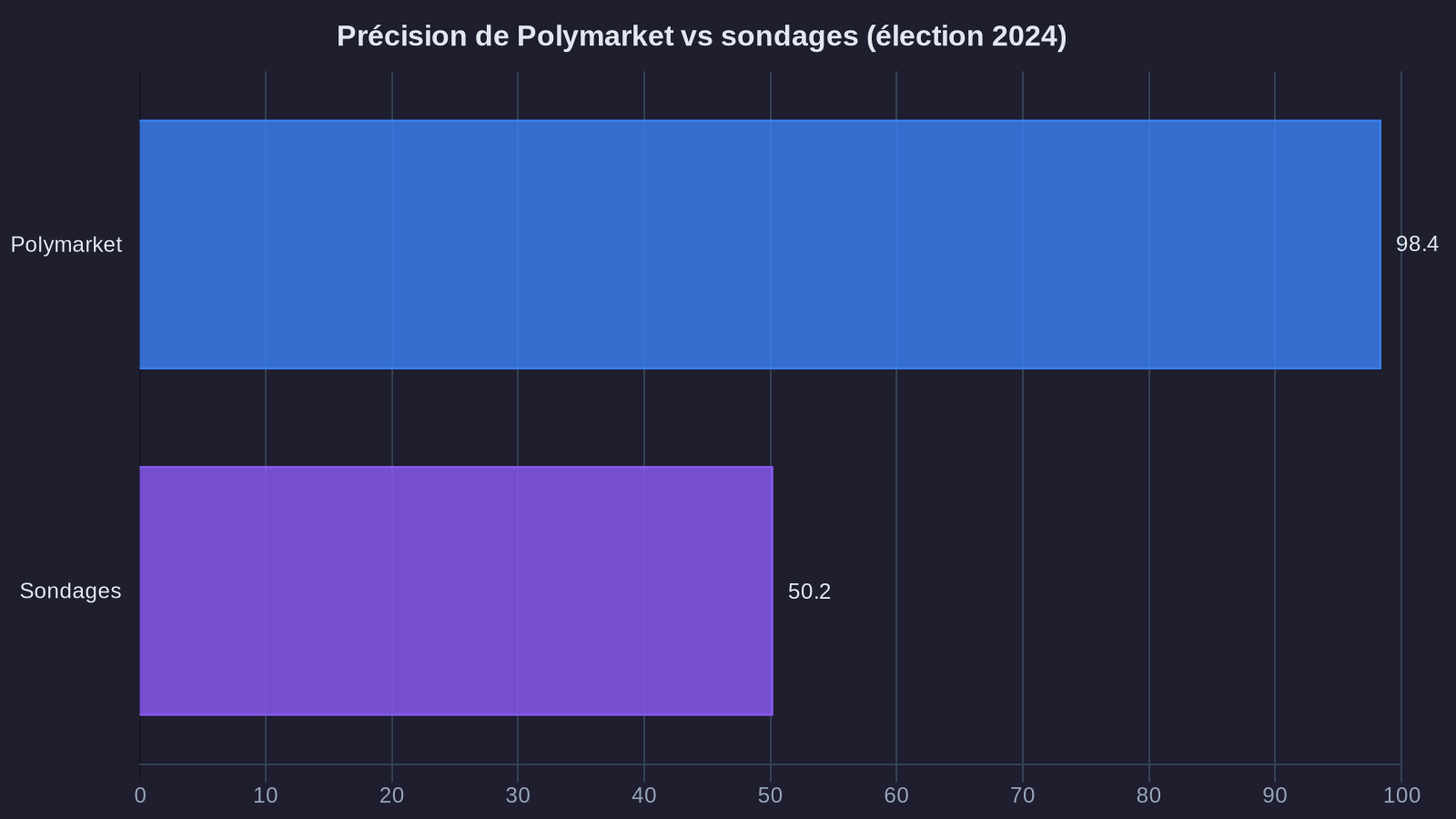
On November 6, 2024, Polymarket displayed a 98.4% probability of a Donald Trump victory. Traditional polls indicated a tight race. A few hours later, official results confirmed Polymarket's figures. Over $3.2 billion had been exchanged on this presidential election. Decentralized prediction markets had just proven their ability to capture reality before traditional institutions.
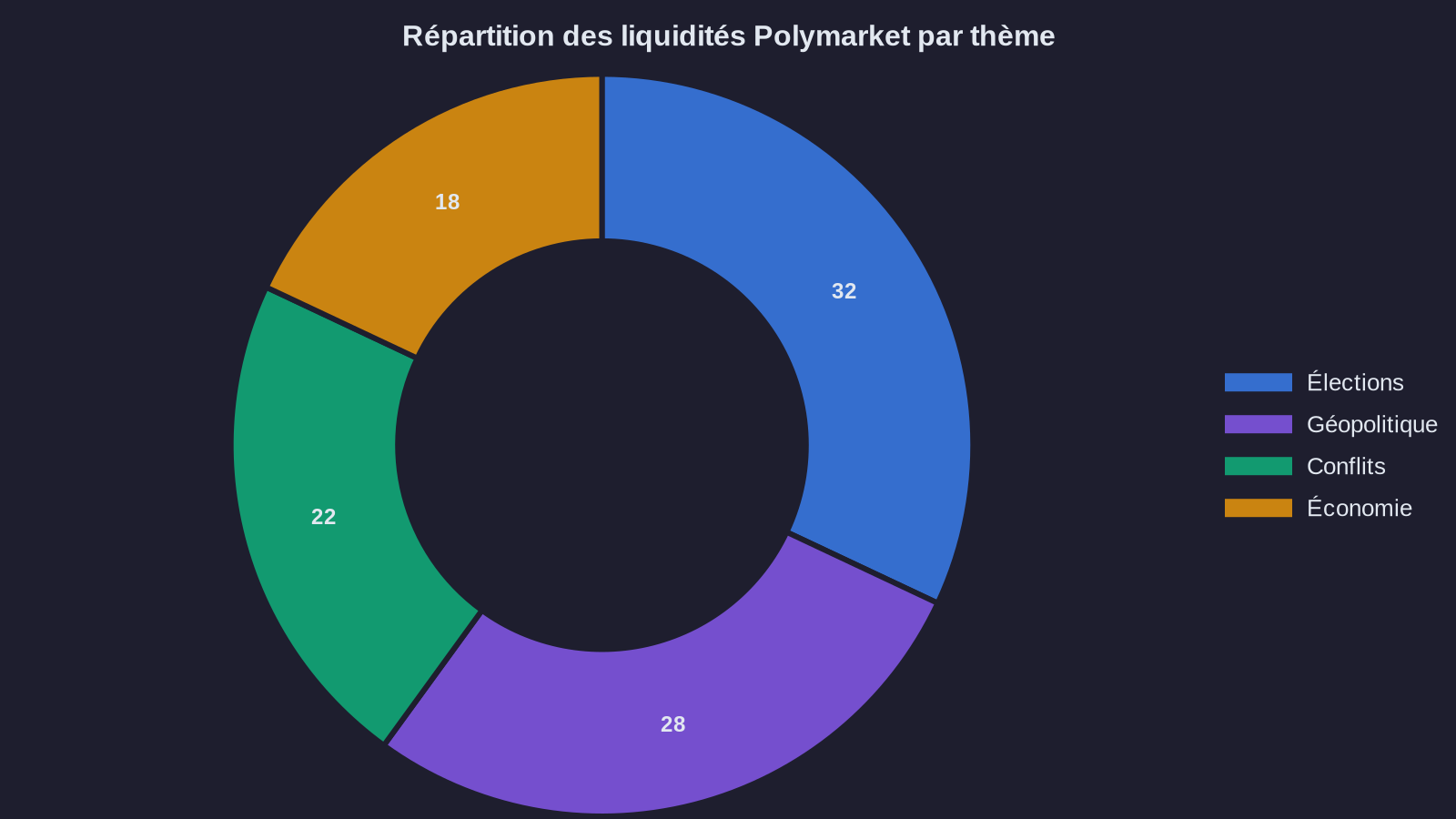
What began as an online betting tool is now evolving into a geopolitical analysis instrument. Polymarket today aggregates $2.4 billion in liquidity across events ranging from tensions in the South China Sea to Israeli-Palestinian negotiations. Institutional investors, risk analysts, and some government offices consult these data. The question is no longer whether prediction markets work, but how their adoption changes the very nature of strategic foresight.
How Polymarket captures geopolitical signals before the media
A prediction market operates on a simple principle: participants bet on the probability that an event will occur. If you believe a conflict will break out before a given date, you buy shares at a certain price. If the event happens, your share is worth $1. If not, it's worth $0. The equilibrium price reflects the collective probability estimated by all participants.
This mechanism holds a decisive advantage over polls or expert analysis: it commits participants financially. Nobody bets $50,000 on an imminent conflict without having solid information or analysis. Large positions reveal strong conviction, typically grounded in diverse sources, local contacts, or ground data inaccessible to the general public.
On February 14, 2025, Polymarket quoted a 73% probability of military escalation between Iran and Israel before the end of March. Two days before the official announcement of an Israeli airstrike operation in Syria, this probability had risen to 81%. Order flows showed a concentration of significant purchases from addresses that had historically anticipated other regional tensions correctly. Traditional media were still discussing diplomatic de-escalation.
This capacity for anticipation rests on aggregating weak signals. Unlike an isolated analyst, a prediction market simultaneously captures the intuitions of thousands of participants from varied backgrounds: crypto traders, former diplomats, specialized journalists, satellite imagery experts. Each participant brings a fragment of information. The equilibrium price synthesizes these fragments into a readable probability, much like what occurs on other prediction market platforms like Kalshi.
Structural limitations: manipulation, liquidity, and cognitive biases
This model has flaws. The first concerns liquidity. On a low-liquidity market, a few large positions are enough to distort displayed probabilities. In January 2025, a user injected $200,000 into a market predicting a Chinese military intervention in Taiwan. The displayed probability jumped from 12% to 34% in less than two hours. Other participants quickly arbitraged this position, bringing the probability back to 18%. But during that window, the displayed information was misleading.
Intentional manipulation poses a more serious problem. A state or interest group could theoretically buy massive share positions on an event to create a perception of imminence. If enough economic actors adjust their positions in reaction, this manipulation can generate real effects: capital flight, commercial contract breakdowns, panic movements. The prediction market then becomes a tool of influence rather than an analytical tool.
Collective cognitive biases also play a role. Prediction markets are not immune to bubble phenomena or panic. When a domino event occurs, collective momentum can overestimate the probabilities of related events. After Russia's invasion of Ukraine in February 2022, prediction markets massively overvalued the probability of nuclear escalation or NATO-Russia conflict. Geopolitical reality proved more stable than the displayed probabilities suggested.
Finally, Polymarket's very structure introduces a technical constraint: the platform operates on Polygon, an Ethereum layer-2 blockchain. Transactions require stablecoins (primarily USDC). This dependence on crypto infrastructure limits access to participants familiar with these tools. Traditional actors—institutional investors, government analysts—can consult the data but rarely participate directly. This asymmetry partially reduces the diversity of captured signals.
Regulators facing a decentralized predictive tool
The U.S. Commodity Futures Trading Commission (CFTC) engaged in legal battle against Polymarket in 2022. The accusation: offering unregulated betting contracts to American citizens. Polymarket paid a $1.4 million fine and committed to blocking American IP addresses. Since then, the platform operates officially outside the U.S. while remaining accessible via VPN.
This regulatory position reveals a fundamental tension. American authorities view prediction markets as financial instruments that should be regulated the same way as derivatives products. But Polymarket rests on decentralized architecture. Smart contracts operate autonomously. No central entity controls capital flows or can shut down a specific market. The regulator can block access to the web interface, but not to the underlying protocol.
The European Union takes a different approach. The MiCA regulation (Markets in Crypto-Assets), which entered into force in January 2025, imposes transparency and anti-money laundering obligations for crypto platforms operating in Europe. Polymarket does not hold a MiCA license. Technically, the platform is inaccessible from Europe. In practice, thousands of European users continue to access it via workarounds.
Some states see these tools as a risk to stability. A market predicting with high probability a coup or banking crisis can trigger preventive behaviors that amplify the initial risk. The Bank for International Settlements published a report in December 2024 highlighting the systemic risk of prediction markets applied to sensitive financial or political events. The recommendation: ban markets on events whose public prediction could influence their realization.
This position opens a philosophical debate. If a tool correctly predicts a crisis, should you ban the tool or address the causes of the crisis? Prediction markets don't create geopolitical tensions. They make them visible earlier. Blocking this visibility doesn't eliminate the underlying risk.
What ForYield thinks
At ForYield, we integrate Polymarket data into our macro risk analysis. Not as a sole source, but as a complementary indicator alongside on-chain flows, Bitcoin-traditional asset correlations, and institutional liquidity movements. When Polymarket displays a high probability of geopolitical escalation in a given area, we adjust our exposure to correlated assets: temporary reduction in certain low-liquidity altcoins, strengthening positions in Bitcoin and stablecoins.
Decentralized prediction markets don't replace fundamental analysis. They complement our understanding of market sentiment and collective expectations. A significant gap between the probability displayed on Polymarket and our own assessment prompts us to deepen our research. Either we missed a signal, or the market is overestimating a risk. Either way, the information has value.
The regulatory question concerns us. A blanket ban would push these tools toward even less transparent jurisdictions. We prefer a framework that regulates without stifling: transparency obligations for large flows, bans on markets for events whose prediction creates direct systemic risk (attacks, political assassinations), continued access for qualified users. Prediction markets can coexist with intelligent regulation. It just requires regulators to accept dealing with infrastructure they don't fully control.
For our clients, our recommendation remains the same: diversify information sources, never invest based solely on a Polymarket probability, but don't ignore what these markets reveal either. Capital flows committed to a geopolitical event often contain more truth than ten analyses from unengaged experts.