
CoinShares just announced its Nasdaq IPO through a SPAC merger valued at $1.2 billion. For many observers, it's just another corporate transaction. For those who've been tracking crypto market evolution over the past decade, it's far more significant: it represents the definitive validation of professional infrastructure around digital assets.
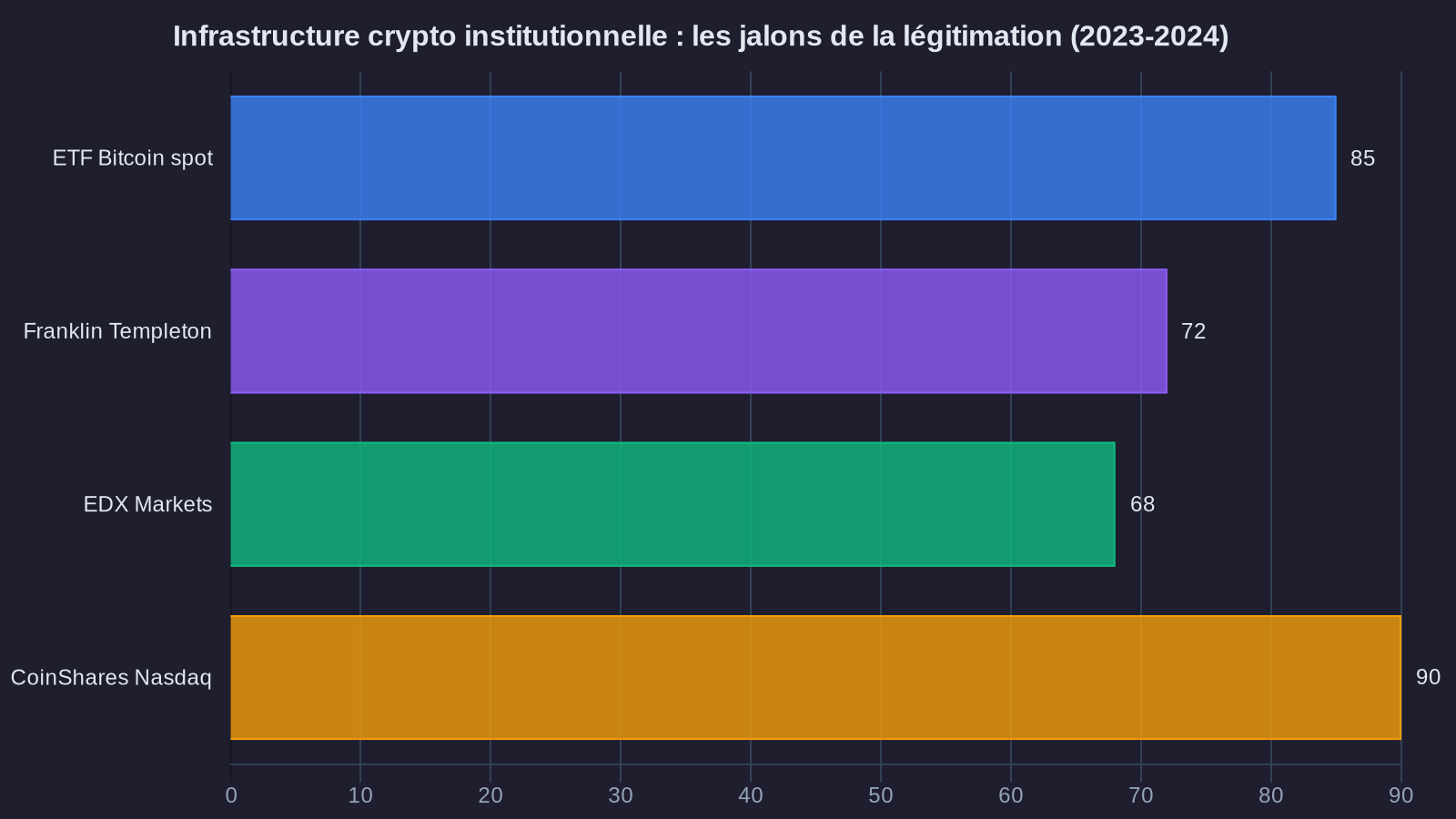
When a European crypto-focused asset manager goes public on the Nasdaq — the heart of American fintech — and nobody cries foul, something fundamental has shifted. This milestone comes as Franklin Templeton launches crypto products, EDX Markets (backed by Fidelity, Schwab, and Citadel) operates an institutional trading platform, and spot Bitcoin ETFs collect tens of billions of dollars.
The professional crypto market is no longer an experimental niche. It's becoming a full-fledged segment of the global financial industry.
CoinShares Nasdaq IPO: From European Pioneer to Listed Crypto Asset Manager
Founded in 2014, CoinShares was built on a conviction: crypto-assets deserved professional management, with institutional standards for compliance, reporting, and governance. For years, this approach seemed contrarian in a sector dominated by retail exchanges and speculative pure-plays.
Today, CoinShares manages approximately $6 billion in assets, primarily through listed products in Europe (Bitcoin and Ethereum ETPs) and crypto hedge fund services. The firm operates under licenses in several European jurisdictions and maintains custody and compliance standards comparable to traditional asset managers.
The $1.2 billion SPAC merger values CoinShares at roughly 20% of its assets under management — a multiple that reflects both the sector's growth premium and recognition of the regulatory infrastructure it's built. By contrast, traditional asset managers typically trade at 2% to 5% of AUM, but with lower operating margins and structurally slower growth.
What makes this crypto asset manager IPO significant is the timing. CoinShares isn't capitalizing on speculative hype like in 2021. The firm is going public in a mature market, following US spot Bitcoin ETF approvals, in an environment where European regulators (via MiCA) and American regulators (via the SEC under new leadership) are progressively clarifying the framework for crypto-assets.
The Institutional Adoption Context: Wall Street is No Longer Experimenting—It's Deploying
CoinShares' Nasdaq entry doesn't happen in isolation. It's part of a sequence of events that, taken together, paint a clear trend: institutional adoption of crypto-assets is moving from pilot phase to operational deployment.
Franklin Templeton, a $1.5 trillion asset manager, launched its own spot Bitcoin ETF in 2024 and is developing blockchain infrastructure for tokenizing traditional assets. This isn't an innovation lab experimenting on the sidelines—this is Franklin's core business integrating blockchain rails into its management processes.
EDX Markets, a trading platform backed by Fidelity Digital Assets, Charles Schwab, and Citadel Securities, has operated since 2023 a crypto exchange infrastructure compliant with US institutional standards. No 100x leverage, no exotic tokens—just Bitcoin, Ethereum, and a few major liquid assets, with custody and settlement processes adapted to the regulatory constraints of American financial institutions.
US spot Bitcoin ETFs have collected more than $30 billion in net inflows since their January 2024 launch. BlackRock's IBIT alone exceeds $50 billion in assets. These volumes aren't coming from retail speculators—they're coming from family offices, RIAs (Registered Investment Advisors), and pension funds allocating 1% to 3% of their portfolios to Bitcoin through a familiar, regulated wrapper.
In this context, CoinShares' Nasdaq IPO validates a business model: you can build a crypto asset management firm with institutional standards, raise capital on public markets, and operate under strict regulatory oversight. This is exactly what professional allocators were waiting for to scale up significantly.
What This Changes for the Professional Crypto Market
This public listing creates three structural effects on the market.
First effect: accounting and regulatory standardization. A Nasdaq-listed company must publish audited financial statements under US GAAP standards, maintain certified internal controls (Sarbanes-Oxley), and meet SEC transparency obligations. CoinShares becomes a case study for regulators and other managers: how do you value crypto-assets on a balance sheet? How do you handle custody? What operational risks must you disclose? The answers CoinShares provides in its 10-K and 10-Q filings will set the standard for the entire sector.
Second effect: legitimizing professional crypto strategies. For years, proposing a crypto allocation in an institutional portfolio was a matter of personal conviction, often pursued outside formal processes. With listed, audited, and regulated crypto asset managers, the argument "it's too risky, it's unregulated" loses its power. An investment committee can now compare CoinShares to Grayscale, to BlackRock (via IBIT), and integrate a crypto allocation into its standard manager RFP process.
Third effect: access to capital for growth. European crypto firms have long struggled with limited access to institutional capital. Banks frequently refused to open accounts, insurers didn't offer appropriate policies, institutional investors avoided the sector out of regulatory caution. By listing on Nasdaq, CoinShares gains access to American capital—the world's deepest and most liquid—and can fund its development (acquisitions, geographic expansion, new products) at financing costs comparable to traditional players.
What ForYield Thinks
CoinShares' $1.2 billion Nasdaq IPO confirms what we've observed over the past 18 months: the institutional crypto market has exited the experimental phase. Professional allocators are no longer waiting five more years to "see what happens." They're deploying capital—significant amounts—through regulated vehicles and listed counterparties.
At ForYield, we build our crypto-asset yield strategies with that same institutional rigor: segregated custody with regulated depositories, transparent reporting, DeFi protocol due diligence processes aligned with professional standards. Our clients—family offices, wealth managers, business leaders—aren't seeking speculative exposure to the latest memecoin. They want a crypto allocation managed with discipline, in a secure framework, with risk-adjusted return objectives.
CoinShares' Nasdaq entry validates this positioning. It sends a clear signal to allocators still on the fence: professional crypto infrastructure exists, it's operational, it's listed on public markets, it's audited. The "when" of institutional adoption is no longer an open question. The relevant question becomes: "how do we structure this allocation so it fits into our existing management framework?"
That's precisely the question we answer at ForYield, strategy by strategy, with the same rigor as a traditional manager—but on an asset class that offers structurally different return opportunities.