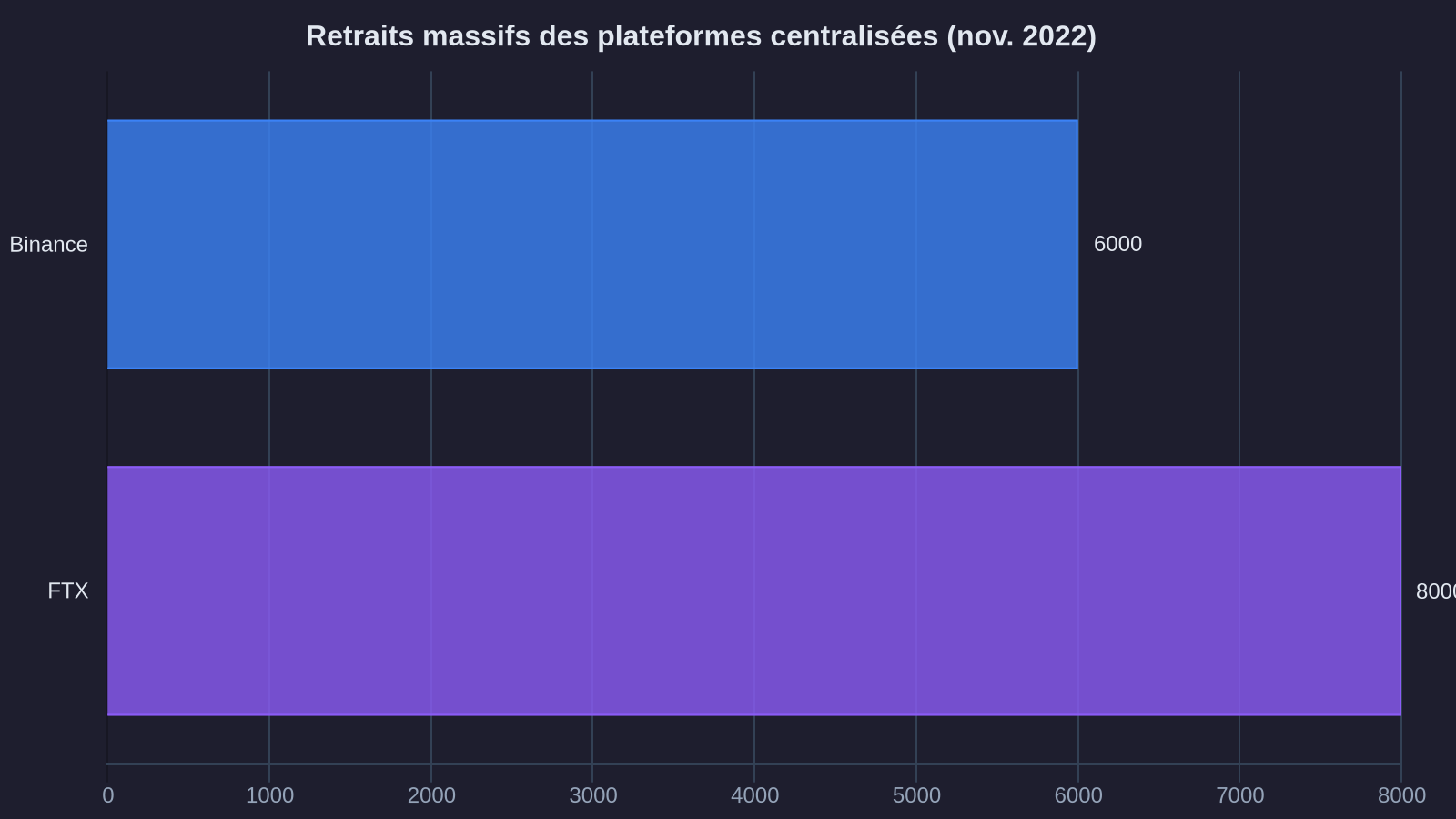
November 2022. Binance experiences a massive $6 billion withdrawal in under 72 hours. Weeks earlier, FTX collapses, taking $8 billion in customer assets down with it. These events marked a turning point: for the first time in years, trading volumes on Uniswap, Curve, and other decentralized platforms are growing significantly at the expense of centralized players.
This shift is more than an emotional reaction. It reflects a deep awakening about the nature of risk in the crypto-asset universe. When a centralized platform holds your assets, you're no longer an owner: you're a creditor. The distinction may sound technical. Yet it's fundamentally decisive.
What recent bankruptcies revealed about centralized platform security
Investors thought they were entrusting their crypto-assets to solid infrastructure. They discovered that many centralized platforms were practicing what's euphemistically called "fractional reserve management": using customer deposits to finance other operations, much like a bank lending out your savings.
Except a bank is regulated, subject to strict capital ratios, and monitored by supervisory authorities. Centralized crypto-asset platforms often operated in a regulatory vacuum, with no deposit guarantees, no genuine independent audits, and sometimes no segregation of customer assets.
Imagine depositing your money in a safe deposit box. You assume your cash stays in your compartment, under lock and key. In reality, the box manager uses it for his own investments, hoping to put it back before you come looking for it. When his bets go bad, your compartment is empty. That's exactly what happened with FTX, Celsius, BlockFi, and others.
The numbers speak for themselves: according to Chainalysis, over $16 billion in customer assets were frozen or lost during centralized platform bankruptcies in 2022 and 2023. This isn't theoretical risk. It's risk that materialized, at scale, affecting both retail investors and institutional funds.
How decentralized exchanges (DEX) and non-custodial trading work
A decentralized exchange, or DEX, operates on a radically different principle. There's no intermediary taking custody of your assets. You remain in possession of your crypto-assets until the precise moment of exchange.
Let's revisit the safe deposit analogy. With a DEX, it's as if you keep your cash in your pocket. At the moment of exchange, you meet your counterparty directly, cash changes hands, and everyone leaves with what they came for. No one else ever has access to your money in the meantime.
Technically, DEXs use smart contracts: computer programs that automatically execute the terms of an exchange. You connect your wallet, authorize a transaction, the exchange happens instantly and verifiably on the blockchain. At no point does the platform hold your funds.
This architecture eliminates what's called counterparty risk: the risk that an intermediary goes bankrupt, disappears with your assets, or uses them without your knowledge. On Uniswap, Curve, or dYdX, this risk doesn't exist by design. You can lose money on a bad trade, on price fluctuation, but not because the platform misappropriated your assets.
Smart contract risks and limitations to understand
This architecture offers significant advantages, but it's not risk-free. Smart contract code can contain vulnerabilities. In 2023, several decentralized protocols suffered attacks exploiting programming errors, resulting in losses for users.
There's also liquidity risk: on a decentralized exchange, you're trading against liquidity pools supplied by other users. If these reserves are shallow, a large buy or sell order can experience significant slippage—a gap between expected price and execution price.
Finally, user experience remains less seamless than on a centralized platform. You must manage your own wallet, understand network fees (gas fees), and validate each transaction. For a novice user, the learning curve is real.
Why this shift is accelerating now
Several factors converge. First, technical maturity. DEX interfaces have improved dramatically. Solutions like MetaMask or Rabby Wallet make access simpler. Transaction fees have fallen with the emergence of layer-two blockchains and alternative networks to Ethereum.
Second, regulatory pressure. In the United States and Europe, authorities are beginning to impose strict obligations on centralized platforms: asset segregation, regular audits, restitution guarantees. Some platforms prefer to restrict their offerings or exit certain markets rather than comply. Users find themselves forced to seek alternatives.
There's also a philosophical dimension. Many investors are rediscovering what originally motivated the emergence of crypto-assets: reclaiming control of their money, reducing dependence on intermediaries. Recent bankruptcies reminded everyone that entrusting assets to a centralized entity, however reputable, means betting on its solvency and honesty.
We're seeing this shift in the numbers. In 2023, Uniswap processed over $700 billion in volume, compared to roughly $400 billion in 2021. The DEX market share of total crypto-asset trading volume rose from 10% to over 15% during the same period. It's not yet dominant, but the trend is clear.
What to know before making the switch
Moving to a decentralized exchange means accepting that you're your own custodian. This requires understanding how non-custodial wallets work, securing your private keys, and verifying contract addresses before each interaction. A handling error can result in permanent loss, with no recourse.
It also means accepting that liquidity can sometimes be lower, especially for less common trading pairs. Network fees can be volatile: on Ethereum, they fluctuate significantly depending on network activity. Sometimes it's more economical to wait a few hours before executing a transaction.
But for those willing to invest the learning time, the reward is substantial: truly controlling your assets, eliminating the risk of having funds frozen or misappropriated by a third party, and accessing complete transparency in exchange conditions.
This move toward decentralization doesn't mean centralized platforms will disappear. They retain advantages for users who prioritize simplicity, customer support, or access to advanced lending and trading services. But their dominant position is eroding. The era when entrusting crypto-assets to a centralized platform seemed obvious is over.
Toward genuinely disintermediated finance
What's at stake today transcends the simple question of exchanges. It's a redefinition of power dynamics in the crypto-asset ecosystem. Investors now demand to know where their assets are, who has access to them, and under what rules. They increasingly reject situations where an opaque intermediary holds discretionary power over their money.
This evolution presents challenges. Regulators must figure out how to oversee protocols without a centralized legal entity. Users must develop skills to navigate this more demanding environment. Developers must continue improving the security and usability of decentralized tools.
But it also carries a promise: that of finance where trust rests not on an intermediary's reputation, but on code verifiability and operational transparency. Finance where everyone remains master of their assets, with the responsibilities that entails, but also with the security it provides.
Investors migrating today to Uniswap, Curve, or other decentralized alternatives aren't just fleeing centralized platform risks. They're voting for a different model. A model where technology replaces blind trust, where transparency trumps opacity, where individual responsibility becomes the price of financial sovereignty.