A manager presents you with an investment showing 12% annual returns. The French savings account caps out at 3%. Your banker mentions 4% on a euro fund. Naturally, you wonder what justifies this gap. The answer comes down to one sentence: the risk you're taking is not the same.
This relationship between higher returns and higher risk is not arbitrary convention. It's a market law that applies to everyone, from individual investors to hedge funds. Understanding this mechanism prevents you from confusing opportunity with pitfall. Here's how to decode what really hides behind those return figures.
The price of risk: an unforgiving market mechanism
In financial markets, returns compensate for two distinct things. First, giving up immediate access to your money: you lend your euros, you can't use them for a defined period. Second, and more importantly, the risk of capital loss that you agree to bear.
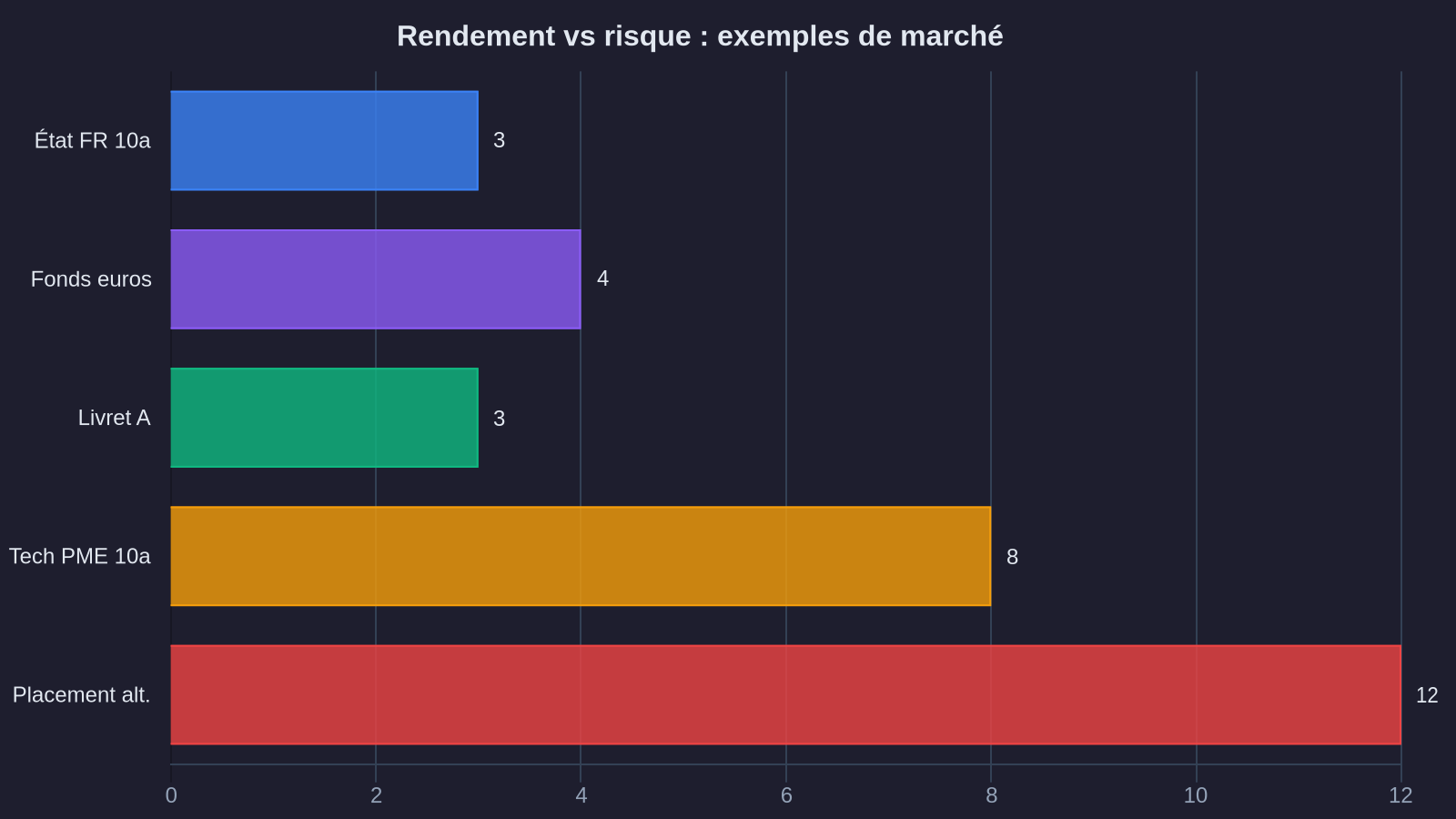
Let's take a concrete example. The French government borrows today at 10 years around 3%. Why so low? Because markets consider the risk of French government default as virtually zero. You'll get your capital back, barring major geopolitical upheaval. This 3% rate becomes the benchmark: it's what we call the risk-free rate, even though it technically carries a tiny residual risk.
Now, a technology company wants to borrow over the same period. It will have to offer 6%, maybe 7%. Why? Because it can go bankrupt. Its revenues depend on economic cycles, innovation, competition. Lenders demand compensation for this additional risk. This is the risk premium: the spread between the proposed return and the risk-free rate.
This logic applies to all investments. A 12% return when the risk-free rate is 3% signals a 9-point risk premium. This gap doesn't come out of thin air. It reflects a probability of loss that the market has assessed, even if implicitly.
Three risks hidden behind attractive returns
A high return can mask several types of risks, often combined. The first, the most visible, is default risk. The borrower or issuer may fail to honor its commitments. A corporate bond offering 10% might seem generous, until you realize the company has rising debt and shrinking margins. The market anticipates future difficulties. The high return compensates for this probability of non-repayment.
The second risk, less intuitive but equally real, is liquidity risk. Some investments promise attractive returns because you can't easily get your euros back. Either because there's a contractual lock-in period, or because the secondary market doesn't exist or is shallow. You can theoretically sell, but finding a buyer at the advertised price is an uphill battle. This illiquidity justifies part of the compensation offered.
The third risk, often underestimated, is volatility risk. Even if you recover your capital eventually, your investment's valuation can fluctuate wildly in the meantime. An equity fund promising 8% annually over 10 years might lose 30% in any given year. Statistically, the average return holds up. Psychologically and financially, weathering a 30% decline requires resilience that not everyone possesses. This uncertainty about the journey justifies part of the announced return.
Complex strategies that artificially inflate advertised returns
Some products display high returns not because they take more risk on the underlying asset, but because they use strategies that amplify gains... and losses. This is the case with leveraged products. You invest 10,000 euros, the product borrows an additional 10,000 euros to invest 20,000 euros. If the market rises 5%, you gain 10% on your initial investment. But if the market falls 5%, you lose 10%. Potential return increases, risk too, in the same proportions.
Other structured products use option mechanics that promise attractive returns in favorable scenarios, but expose you to significant losses if the market doesn't behave as expected. The advertised return corresponds to the base case, not the worst case. The prospectus mentions risks, often on page 47, in technical jargon that discourages reading. The return figure, meanwhile, appears on the first page in large type.
How to evaluate if a return justifies the risk taken
When presented with an investment proposal, the first question to ask is not "what's the return?" but "what risk must I accept to get this return?" This question calls for three others, concrete and verifiable.
First: what could go wrong? Identify loss scenarios. Can the issuer default? Is the sector undergoing brutal consolidation? Does the secondary market liquidity really exist or only on paper? If you can't find a clear answer to this question in the documentation, that's a red flag. A serious product exposes its risks factually, without downplaying them.
Next: how much can I lose in a realistic worst-case scenario? Not the catastrophic scenario where everything collapses at once, but the unfavorable scenario with a non-negligible probability of occurring. If you invest 50,000 euros at 10%, what maximum loss can you sustain before needing to sell? 5,000 euros? 15,000 euros? 30,000 euros? This answer should come before looking at the advertised return. To explore this further, read our article on counterparty risk.
Finally: what portion of my wealth can I allocate to this risk level? An investment promising 12% with 40% capital loss risk can have its place in a diversified portfolio, at 5% or 10% of total wealth. It becomes toxic if it represents 50% or 80% of your savings. Acceptable risk depends on your overall situation, not just the attractiveness of the isolated product.
Questions to ask before investing
When a manager or advisor presents an investment to you, three questions test the solidity of the proposal. First question: "Why is this return higher than the current risk-free rate?" The answer must be precise. If it remains vague ("because it's a good investment" or "because we have proprietary strategy"), push back. A risk premium always justifies itself through an identifiable risk.
Second question: "Under what conditions could I lose some or all of my capital?" This question makes people uncomfortable. It forces your counterpart out of sales pitch mode and into fact mode. A competent professional will answer straightforwardly. A pressured salesperson will evade or downplay. Our guide on words that signal red flags in financial offers will help you spot misleading language.
Third question: "How did this type of investment perform during the last market crisis?" Past returns don't predict future ones—that's obvious. But observing how a product behaved during a stress episode (March 2020, the 2023 liquidity crisis) gives an indication of its resilience. If the product didn't exist yet or hasn't gone through a rough patch, you have no track record to assess its behavior under pressure. That's an additional risk.
Return and risk in decentralized finance
Decentralized finance, often associated with crypto-assets and decentralized protocols, illustrates this relationship between return and risk in radical fashion. Some lending or liquidity provision protocols display double-digit annual returns, sometimes beyond 20%. These figures attract. They also signal a combination of risks specific to this universe.
Technology risk comes first. A protocol runs on code. A flaw in that code can allow an attacker to drain deposited funds. Security audits reduce this risk, they don't eliminate it. Protocols audited by several recognized firms have suffered exploits. High returns partly compensate for this exposure to technical risk you can't control.
Liquidity risk is also present. Some protocols theoretically allow you to withdraw your funds anytime. In practice, during a panic movement, available liquidity can evaporate in minutes. You might find yourself locked in, unable to exit when you need it most. High returns also compensate for this structural fragility.
Finally, regulatory risk looms. Regulatory authorities are watching this ecosystem closely. A ban, sudden restriction, or unexpected compliance requirement could overturn a protocol's economics overnight. This risk is hard to quantify. It translates into permanent uncertainty about whether current conditions will persist.
These risks don't mean decentralized finance should be avoided. They mean a 15% or 20% return in this universe isn't comparable to a 5% return on a government bond. The nature of the risk is different, its magnitude too. Comparing the two without adjusting for risk is like comparing apples to airplanes.
Building a strategy aligned with your risk tolerance
The question isn't to avoid risk at all costs. It's to calibrate it based on your situation, objectives, and ability to sustain temporary or permanent losses. A young professional saving for a project 15 years away can accept high volatility on part of their portfolio. A retiree depending on investment income to live can't afford the same exposure.
Diversification smooths risks. Rather than putting 100,000 euros into a 12% investment with 50% capital loss risk, you might split: 40,000 euros in government bonds at 3%, 30,000 euros in solid corporate bonds at 5%, 20,000 euros in a diversified equity fund targeting 8%, and 10,000 euros in a riskier investment at 12%. Overall return drops. So does the risk of losing everything.
This allocation isn't a magic formula. It illustrates a principle: your portfolio's overall return should reflect the risk level you're willing to assume across your entire wealth, not investment by investment. A risky asset at 15% might fit if it represents 5% of the total. It becomes dangerous if it represents 60%.
Before allocating your euros, ask yourself this: if this investment loses 30% of its value tomorrow, does my financial situation remain viable? If the answer is no, reduce exposure. If the answer is yes, you've correctly sized your risk. The return will come, or it won't. But you won't jeopardize your financial balance seeking it.
One last point, often neglected: information transparency. An investment that hides its risks or buries them in incomprehensible jargon doesn't deserve your trust, regardless of advertised return. A serious issuer explains where the return comes from, what risks justify it, and under what conditions you could lose. If this information isn't accessible in plain language, pass. Return never compensates for opacity.