
One investment offer displays "8% target return". Another promises "7% guaranteed". A third mentions "10% historical performance". These three figures look similar. Their legal meaning, financial implications, and the level of risk they entail are radically different.
Most investors never read a full prospectus. It's a fact. Regulators know it, professionals know it. That's why the vocabulary used in a financial offer is strictly regulated. Every word matters. Learning to decode them lets you assess the real risk of an investment in seconds, before even opening the full documentation.
This article details what the most common terms really mean, what they reveal about the strength of a promise, and the red flags you should never ignore.
The language of returns: what it really means
Financial vocabulary isn't chosen randomly. Behind each formulation lies a legal obligation, a contractual commitment, or, conversely, the complete absence of any guarantee. Understanding these nuances helps you avoid taking on risks you didn't anticipate.
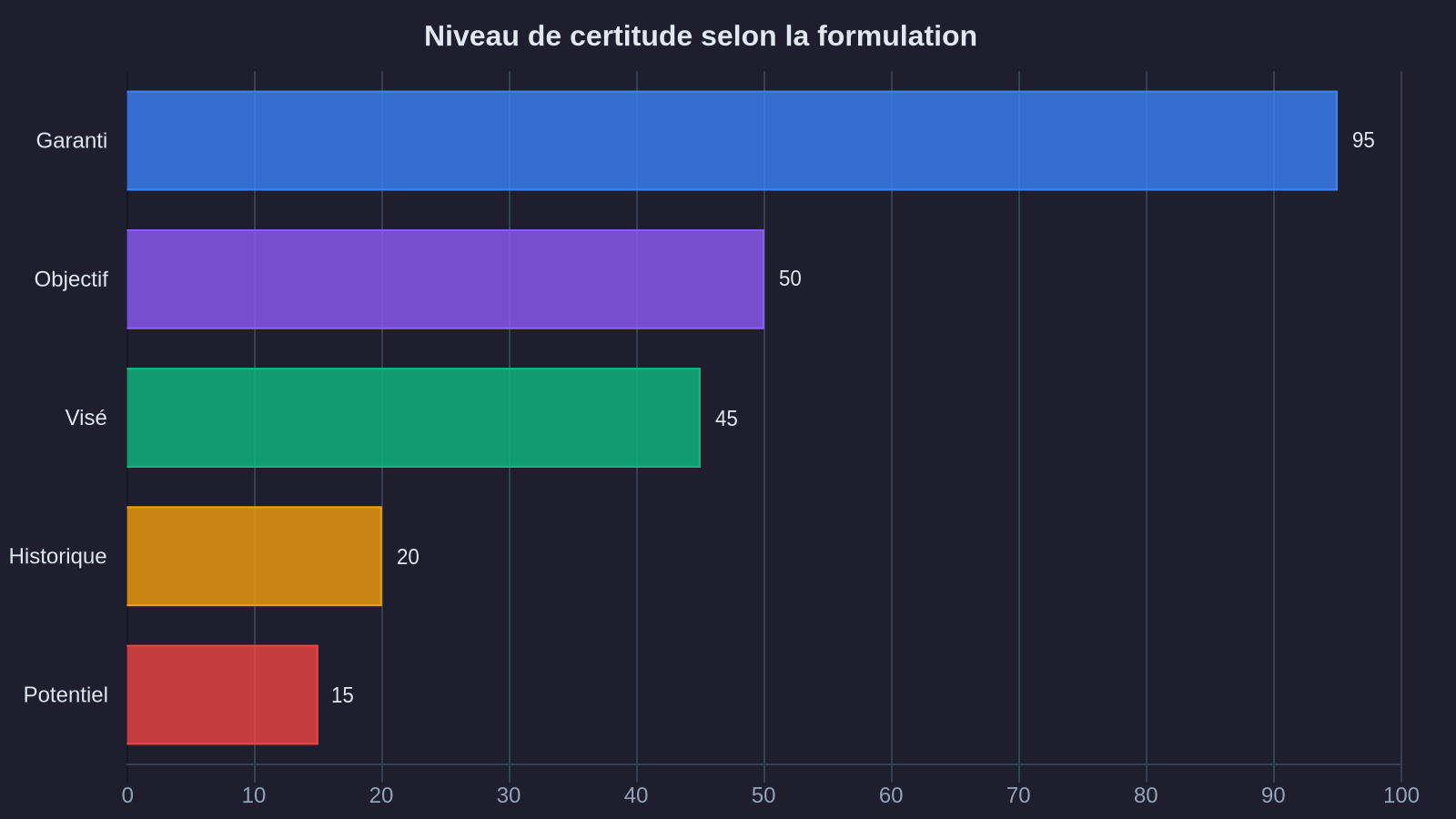
"Guaranteed": a legally binding promise
When an investment displays a guaranteed return, it means that an entity — bank, insurer, or state — commits contractually to pay you that amount. The French Livret A savings account, life insurance euro funds, French government bonds: these products guarantee your capital and, in some cases, a predetermined interest rate.
This guarantee comes at a cost: it depends on the issuer's financial strength. If a bank fails, your capital is protected up to €100,000 by the Deposit Guarantee and Resolution Fund. Beyond that, you become a creditor of the bank, with the associated risk of loss. A guarantee is only as solid as the entity standing behind it.
Practical consequence: a guaranteed investment typically offers low returns, often below inflation. That's the price of security. If an offer promises high guaranteed returns (above 4-5% in today's environment), ask yourself two questions: who is guaranteeing it, and how does that entity finance such returns.
"Target", "aimed at", "objective": intentions, not commitments
A target or aimed at return is not a promise. It's a management objective. The company offering the investment tells you the performance level it aims to achieve, based on its strategy and market conditions. It doesn't commit to reaching it.
Concrete example: an investment fund displays a target return of 6% per year. This figure reflects the fund manager's ambition, not a guaranteed result. If markets decline, if interest rates move unfavorably, if the strategy underperforms, the actual return could be 2%, 0%, or even negative. You could lose part of your capital.
These terms are regulated. An authorized professional cannot use "target" without clearly mentioning associated risks, including the risk of capital loss. If this mention doesn't appear or is relegated to tiny print at the bottom of the page, that's a red flag.
"Historical" or "past" performance: an indicator, not a prediction
Past performance does not predict future results. This sentence appears in every regulatory document, and it's rarely read. Yet it sums up a fundamental principle: what an investment returned in the past tells you nothing about what it will return tomorrow.
A fund that shows +15% per year over 5 years may have benefited from an exceptional bull market. If that cycle reverses, the same fund could lose 20% in a year. Historical data is useful for understanding an asset's volatility, the consistency of a strategy, or resilience during crises. It's never a promise.
Be particularly wary of offers that highlight historical performance without context. An asset that returned 30% last year during a strong market rally tells you nothing about what it will do this year if conditions change. Isolated performance without explanation of the strategy or mention of down periods is a warning signal.
Red flags you should never ignore in a financial offer
Certain formulations or omissions should immediately catch your attention. They reveal either misleading communication, ignorance of the rules, or a deliberate attempt to downplay risk. In any case, they warrant heightened vigilance.
A profit promise without mention of risk
Any financial offer that promises a return — whether target, aimed at, or estimated — without explicitly mentioning the risk of capital loss violates financial communication rules. If you read "Earn 10% per year" without seeing, in the same place and with the same visibility, "Risk of capital loss", close the document.
This rule applies to all materials: website, brochure, email, advertisement. Risk cannot be relegated to the bottom of the page in size 6 font, nor hidden in a 50-page PDF. It must appear at the same level as the return promise. If it doesn't, you're facing non-compliant communication, which says a lot about the issuer's credibility. To verify a platform's regulatory status, consult our guide: "Authorized by the AMF": how to verify a platform isn't deceiving you.
Misleading comparisons with regulated savings
"10 times more profitable than the Livret A", "Replace your euro fund with our solution". These formulations are prohibited for a simple reason: they compare products that are nothing alike. The Livret A is guaranteed by the state, liquid at any time, with no fees. An alternative investment — even a serious one — shares none of these characteristics.
Comparing a risky investment with guaranteed savings is like comparing a sports car with a bus. They're not the same use case, not the same constraints, not the same level of safety. An offer using this rhetoric is trying to create a false equivalence to reassure you. It's a major red flag.
Absence of information about the custodian or asset segregation
When you entrust money to a financial intermediary, your funds must be kept separate from those of the company managing your investment. This is called asset segregation. If the intermediary goes bankrupt, your assets remain yours. They cannot be seized by the company's creditors.
A serious offer always states which regulated custodian holds your funds and how segregation is ensured. If this information doesn't appear anywhere, if the website is vague ("your funds are secure"), if no authorized custodian is named, that's a major operational risk. Your assets could be mixed with the company's cash. If difficulties arise, you become a creditor with low odds of recovery. Recent bankruptcy cases, like CoinEx's closure, illustrate the importance of this check.
How to read an offer in 3 minutes
You don't need to read 200 pages of documentation to assess an offer's credibility. Three quick checks are enough to identify the main risks and warning signals.
1. Look for the risk mention. Open the homepage, marketing brochure, or prospecting email. Does the risk of capital loss appear in the same place as the announced return, with the same font size and visibility? If yes, good sign. If the risk is absent or relegated to the bottom of the page, red flag.
2. Identify regulatory status. Is the entity offering the investment authorized by the AMF, ACPR, or an equivalent European regulator? Is the authorization number mentioned and verifiable on the regulator's website? An unauthorized company can offer investments, but it can't use certain terms (advisor, fund manager) or directly hold your funds. If the status is unclear or absent, ask in writing.
3. Check asset custody. Who actually holds your money or assets? An authorized custodian must be named. If the answer is "us", "our secure platform", or remains vague, your assets probably aren't segregated. That's an operational risk you need to weigh.
These three checks take a few minutes. They don't replace reading the full documentation, but they immediately filter out problematic offers. If an offer fails any of these tests, seek written clarifications before proceeding.
Questions to ask before investing
Beyond reading the offer, certain questions let you test the intermediary's transparency and understand what you're actually buying. A serious professional will answer them in writing, straightforwardly.
"What's the maximum loss scenario?" Every investment carries risk. Ask the intermediary to quantify the worst-case scenario: how much could you lose, under what conditions, over what timeframe. A vague answer ("risk is limited") or minimization ("it never happens") is a red flag. A precise answer ("if the market drops 30%, your capital could fall 20%") shows that risk is measured and acknowledged.
"Can I get my money back anytime?" An investment's liquidity determines your ability to exit if needed or circumstances change. Some investments impose a lock-up period, others allow withdrawal but with fees or delays. Knowing these constraints before investing prevents unpleasant surprises if you need cash.
"What are the real fees, all lines included?" Fees erode returns. Entry fees, annual management fees, exit fees, performance fees: ask for full details, in percentages and euros based on a concrete example. An investment showing 6% target return with 2% annual fees actually returns 4% before taxes. If fees aren't clearly detailed or appear only in an appendix document, that's a point to watch.
What these words reveal about risk level
The vocabulary used in a financial offer is never neutral. It reflects the risk level, regulatory framework, and often the issuer's philosophy. Learning to decode these signals lets you quickly assess whether an investment matches your risk profile and objectives.
An investment using "guaranteed" without naming the guarantee issuer exposes you to unevaluated counterparty risk. An investment displaying a target return but never discussing volatility or loss scenarios downplays risk to seduce you. An investment comparing its performance with the Livret A tries to create a false equivalence to blur your risk perception.
Conversely, an investment using "target return" while detailing the market conditions needed to achieve it, mentioning capital loss risk at the same level as the return promise, naming the custodian and explaining asset segregation shows transparency that's reassuring. It's not a performance guarantee, but it's a sign of seriousness.
Decentralized finance, investment funds, alternative investments: all these products can be legitimate and suited to certain profiles. But they're never risk-free. Reading between the lines of an offer protects you better than a 200-page prospectus that nobody reads.
Before trusting your money, ask yourself this question: do I understand what I'm buying, who I'm giving it to, and what I could lose? If the answer is no, or if the offer remains unclear despite your questions, that's when to walk away.