In November 2022, FTX collapsed. $8 billion in client assets vanished. Just days earlier, the platform still displayed a "solid" balance sheet. Since then, the exchange industry has multiplied announcements: "We're publishing our proof of reserves," "Independent audit available," "Total transparency on our assets."
The problem? Many investors take these statements at face value. They see an audit report, a reassuring figure, and consider the matter closed. That's a mistake. A Proof of Reserves (PoR) is not an absolute guarantee. It's a snapshot, with precise technical limitations you need to understand to truly assess a platform's solvency. After incidents like CoinEx's closure, understanding these mechanisms has become essential.
This guide gives you the tools to analyze these audits like a professional. Not to become an auditor, but to ask the right questions and spot red flags before they become catastrophic failures.
What a Proof of Reserves really reveals
A typical PoR relies on an apparently simple mechanism: the exchange proves it controls blockchain addresses containing at least the amount of client deposits. Concretely, this involves two distinct verifications as part of an exchange security audit.
First, proof of address control. The exchange must demonstrate that it owns the private keys to the on-chain wallets where assets are stored. The standard protocol involves signing a cryptographic message with these keys. Anyone can verify this signature on the blockchain. It's transparent, verifiable, indisputable.
Next, the Merkle tree of liabilities. The exchange calculates the total deposits of all its users and builds a cryptographic structure (a Merkle tree) that allows each client to verify that their balance is included in the global calculation, without revealing other users' amounts. You receive an identifier, you consult the public tree, and you confirm that your balance appears in the total sum.
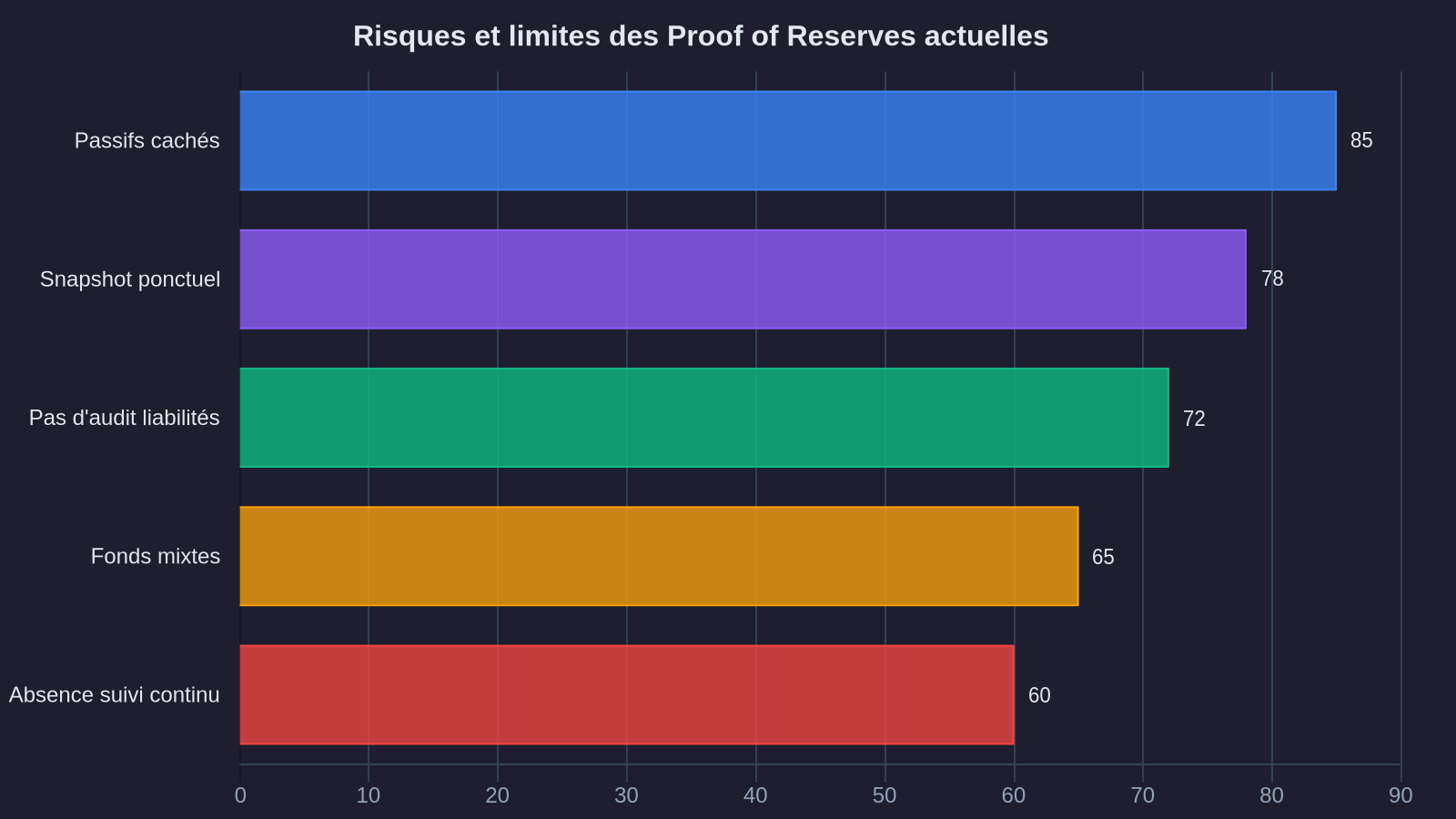
If assets ≥ liabilities, the exchange is "solvent" at that moment in time. That's the theory. In practice, several structural flaws limit the scope of this proof.
The blind spots of the system
First problem: the photographic snapshot. A PoR captures a state at one specific moment. Nothing guarantees that the exchange didn't borrow assets a few hours before the audit to artificially inflate its reserves, then return them immediately after. In 2022, several Chinese platforms were suspected of rotating funds between each other to present flattering balance sheets during simultaneous audits.
Second limitation: lack of visibility on off-balance-sheet commitments. A PoR verifies that the exchange holds X bitcoins for X bitcoins of client deposits. It says nothing about debts incurred elsewhere: undisclosed loans, leveraged positions, derivative contracts, commitments to other platforms. FTX technically had reserves, but had also massively lent those funds to Alameda Research without disclosing it.
Third blind spot: asset fragmentation. Modern exchanges manage dozens of blockchains. A complete PoR should cover Bitcoin, Ethereum, Polygon, Arbitrum, Solana, and all ERC-20, BEP-20 tokens, etc. Many audits only cover major assets. Result: we verify 70% of reserves and extrapolate that the rest follows. That's insufficient for genuine crypto custody verification.
How to analyze a crypto reserve audit report
You're reviewing an exchange's PoR report. Before reassuring yourself, ask these questions in order to ensure true exchange transparency.
Is the audit conducted by a credible independent third party? Check the auditor's name. If it's a recognized accounting firm (Armanino, Mazars, Grant Thornton), that's a positive sign. If the audit is conducted internally or by an unknown entity, be cautious. Some exchanges publish self-certified "proofs" that are worthless.
What proportion of assets is covered? The audit must specify the exact scope. "100% of Bitcoin and Ethereum deposits" is clear. "Majority of major assets" is vague. Demand detailed figures by blockchain and by token. An exchange that only publishes the global total probably hides imbalances on certain assets.
Does the methodology include liability verification? Many audits merely prove control of addresses (assets) without verifying the calculation of client deposits (liabilities). That's insufficient. A complete audit must include Merkle tree construction and allow each user to individually verify their balance's inclusion. If this function doesn't exist, the exchange can artificially inflate the liability amount to create an illusion of solvency.
How frequently is the audit performed? An annual audit protects nothing. Situations can deteriorate within weeks. The most rigorous exchanges publish PoRs monthly, even in real time. Kraken, for example, updates its proofs weekly. Binance publishes quarterly. A wide interval leaves more room for temporary manipulation.
Verifying yourself: tools at your disposal
You don't have to settle for the report alone. Several verifications are accessible without advanced technical expertise.
Start by verifying public addresses. Most exchanges publish the on-chain addresses of their cold wallets. Copy these addresses, paste them into a blockchain explorer (Etherscan for Ethereum, Blockchain.com for Bitcoin, Solscan for Solana). You'll see balances in real time. Compare these amounts with the figures stated in the audit report. A significant discrepancy should alert you.
Next, verify your own inclusion in the Merkle tree. If the exchange offers a PoR verification tool (like Kraken or OKX), use it. You receive a unique hash corresponding to your balance. You compare it to the published tree root. If verification fails or the tool doesn't exist, that's a red flag.
Finally, monitor unusual movements. Before a scheduled audit, observe if massive incoming transfers appear on the exchange's addresses, followed by outflows a few days later. This pattern suggests "window dressing" — temporarily borrowing assets to embellish the balance sheet. Tools like Nansen or Glassnode allow you to trace these flows, but simple manual monitoring on Etherscan can suffice to spot anomalies.
Beyond Proof of Reserves: what the numbers don't tell you
A rigorous Proof of Reserves does not replace complete due diligence. It verifies an assets/liabilities ratio, but ignores essential dimensions of an exchange's soundness.
Legal structure matters as much as reserves. An exchange can hold 100% of client funds and, in case of bankruptcy, see those assets seized by creditors if legal segregation isn't airtight. Coinbase, for example, holds client assets in separate custody structures with qualified custodian status. BitMEX, on the other hand, long mixed operational funds and client deposits. The PoR doesn't reveal this difference.
Operational governance is equally crucial. Who controls the private keys? How many signatories are needed to approve a transfer? Where are backup keys stored? An exchange with complete reserves but failing governance (keys held by a single person, lack of multi-signature) remains vulnerable to internal theft or hacking, as demonstrated by the attack on Revolut via Monero.
Finally, regulation provides a layer of protection that transparency alone cannot offer. Exchanges regulated in Europe (under MiCA) or the United States (with BitLicense or Money Transmitter license) are subject to mandatory external audits, minimum capital requirements, and strict fund segregation rules. These constraints significantly reduce risks, beyond what a voluntary PoR can guarantee.
Building a custodial risk mitigation strategy
Understanding PoR limitations is good. Adjusting your approach accordingly is better. Here's how to integrate this analysis into your crypto wealth management.
Diversify your custody points. Never concentrate your entire portfolio on a single exchange, regardless of audit quality. Spread across multiple regulated platforms, prioritizing those that publish frequent and detailed PoRs. This fragmentation reduces your exposure to the idiosyncratic risk of a single failure.
Calibrate your on-exchange exposure according to your usage. For active trading, you need immediate liquidity: funds stay on the exchange. For long-term holding, systematically withdraw to a personal cold wallet. Rule of thumb: leave on exchange only the amount you need to trade within the next 7 days. Everything else should be in self-custody.
Automate monitoring. Set up alerts on the public addresses of exchanges you use. Tools like Nansen or simply Etherscan notifications warn you of significant movements. A massive reserve withdrawal, a sharp drop in the PoR ratio, or transfers to competing exchanges should trigger preventive withdrawal of your assets.
Prioritize exchanges that go beyond PoR. Some platforms publish comprehensive reports including liabilities, assets, debts, and audited financial statements. Kraken, for example, provides detailed PoR plus quarterly accounting statements. Gemini, regulated by the NYDFS, undergoes mandatory external monthly audits. These additional guarantees are worth the cost of slightly lower market depth or marginally higher fees.
ForYield's take
At ForYield, we never take any PoR at face value. We analyze every exchange before deploying yield strategies on it, and we reassess this selection monthly. Our due diligence process combines PoR, legal structure, regulatory quality, operational history, and key governance. We only use platforms meeting strict criteria: public and frequent PoRs, legal segregation of client funds, regulation in at least one Tier 1 jurisdiction, and no major security incidents in the past 36 months.
Our strategies systematically include multi-custody diversification: no client asset is concentrated on a single exchange. We monitor our counterparties' on-chain addresses in real time and have automated preventive withdrawal procedures if an alert threshold is breached. This approach has a cost—it slightly reduces gross returns—but it's non-negotiable. A portfolio yielding 12% that disappears yields 0%.
Transparency of reserves is progress. But it doesn't replace diversification, rigorous governance, or regulation. Your custody strategy must reflect this reality.
Proof of Reserves has transformed industry standards. They offer unprecedented transparency compared to traditional finance. But they're not all-risk insurance. They photograph an instant, they don't film continuously. They verify a ratio, they don't audit governance. They prove asset possession, they don't guarantee future availability.
Your responsibility, as an investor, is to understand these limitations and adjust your exposure level accordingly. Verify regularly, diversify systematically, withdraw preventively. Transparency is a tool, not a guarantee. It's up to you to use it correctly.