
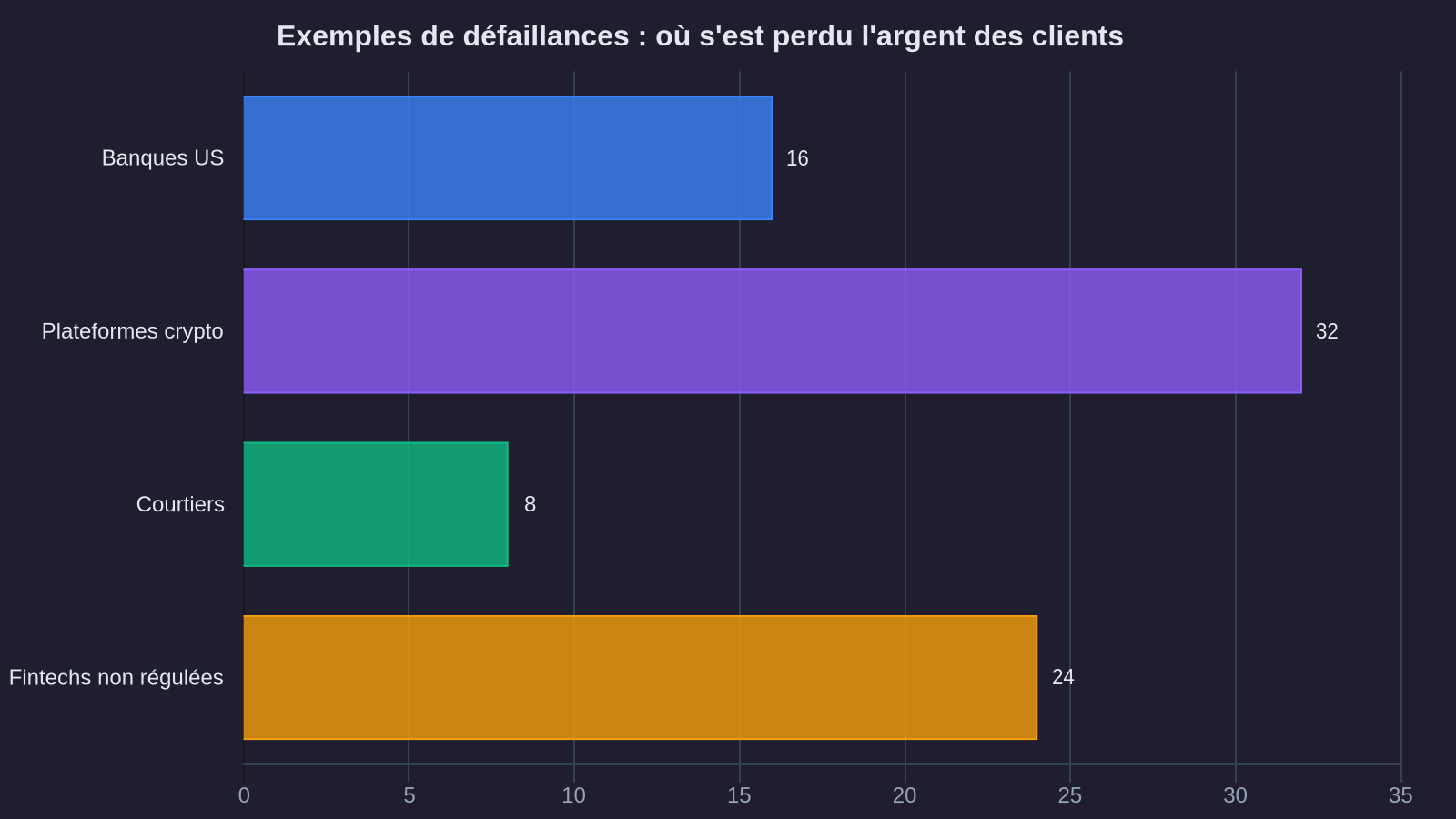
You deposit 50,000 euros into a savings account. A few months later, the institution defaults. You discover your money wasn't where you thought it was, nor protected as you imagined. This scenario isn't theoretical: it has happened repeatedly in recent years, from U.S. regional banks to crypto platforms.
Counterparty risk is precisely that: the risk that the entity holding your money can't return it to you. It's not market risk (your investment declining) or liquidity risk (inability to sell quickly). It's the risk that your counterparty disappears, goes bankrupt, or fails to honor its commitments.
Understanding this risk requires asking three questions: who actually holds my assets? What protects them if the entity defaults? And how can I verify this protection actually exists?
Who actually holds your money
When you deposit money somewhere, the first question to ask is simple: where is it physically? The answer isn't always what you'd expect.
Take a traditional bank. You deposit 10,000 euros into your checking account. That money isn't sitting in a vault with your name on it. The bank uses it to fund loans, bonds, its own operations. Your account shows 10,000 euros, but it's a claim: you have the right to retrieve that amount, not direct ownership of the cash. If the bank fails, you're one creditor among many.
It's different with a securities account at a regulated broker. The stocks and bonds you buy are registered in your name in a ledger separate from the broker's balance sheet. If the broker disappears, your securities remain yours. They're not part of the assets available to pay creditors. This is called segregated assets: they're legally distinct from those of the intermediary.
On an unregulated crypto platform, the situation can be opaque. Some platforms mix client funds with their own treasury. Others lend your crypto assets to third parties to generate returns, without your knowledge. When FTX failed in November 2022, clients discovered their assets had been used to cover losses from other company activities. Result: billions of dollars frozen, years of litigation.
Asset segregation isn't a technical detail. It's the difference between recovering your money in weeks or waiting years for judicial liquidation.
Protection mechanisms in case of financial default
Even with segregated assets, an intermediary can default. That's where protection mechanisms come in: deposit guarantees, guarantee funds, insurance, provider status.
In France, the Deposit Guarantee and Resolution Fund (FGDR) covers bank deposits up to 100,000 euros per person per institution. If your bank fails, you recover up to this limit within seven business days. Beyond that, you enter liquidation proceedings with other creditors. This mechanism protects checking accounts, savings accounts, certain term accounts. Not investments in stocks, bonds, or funds.
For securities accounts, there's another system: the Securities Guarantee Fund, covering up to 70,000 euros per person if the broker can't return securities. But this guarantee only applies in case of proven default, and it doesn't compensate for market declines or undetected internal fraud.
In disintermediated finance, there's no equivalent guarantee fund. Some regulated platforms offer private insurance on held assets, but conditions are often restrictive: high deductibles, numerous exclusions, limited caps. Others rely on a regulated custody provider (a custodian) that legally separates client assets from its own balance sheet. This is real protection, provided you verify the provider exists, is audited, and assets are actually registered in your name.
Counterparty risk never disappears entirely. It shifts. When moving from a bank to a custody provider, you transfer risk from the bank to that provider. The question becomes: is this new third party more reliable, better regulated, more transparent?
Questions to ask before investing your money
Facing any investment offer, there's a set of questions that allow you to concretely measure counterparty risk. These questions guarantee nothing, but they quickly reveal whether the counterparty has structured its setup seriously or is improvising.
First question: where are my assets actually held? If the answer is vague ("on our secure servers," "in our infrastructure"), that's a red flag. A clear answer names a third-party provider, account type (segregated omnibus account, individual account), jurisdiction. If your assets are mixed with the platform's, you're a creditor, not an owner.
Second question: who can mobilize these assets, and under what conditions? Some contracts allow the intermediary to lend, rehypothecate, or use your assets for its own operations. That's not necessarily a problem if it's explicit, regulated, and compensated. It becomes one if it's buried in the terms and conditions. A serious provider details these clauses and limits them contractually.
Third question: what happens if the intermediary defaults? The answer should be procedural, not reassuring. Who intervenes (a liquidator, regulator, trusted third party)? In what estimated timeframe do you recover your assets? What's your priority ranking (secured creditor, general creditor)? If this information doesn't exist or the answer is "we'll never default," move on.
Fourth question: is there a guarantee or insurance, and what exactly does it cover? Insurance against theft or hacking doesn't cover bankruptcy. A guarantee fund doesn't cover management fraud. Read the exclusions. Check the cap. Ask for the insurer's name and check their financial rating. Cosmetic insurance (10,000 euro cap for a 100,000 euro deposit) is worse than no insurance: it creates a false sense of security.
Fifth question: is the provider regulated, and by whom? Being regulated doesn't eliminate counterparty risk, but it imposes audits, capital requirements, oversight. An unregulated provider isn't automatically risky, but it concentrates more risks: internal governance, lack of external control, no disclosure requirements. In case of dispute, you have no ombudsman or regulator to turn to. To verify a platform's regulatory status, consult official registries like the AMF's.
These questions aren't theoretical. They carry a cost: giving up an offer that can't answer them clearly. But that cost is trivial compared to losing part or all your capital because you didn't ask the right question at the right time.
Counterparty risk isn't eliminated, it's managed
No investment completely eliminates counterparty risk. Even government bonds carry sovereign default risk. Even physical gold held by a third party depends on that third party's reliability. What changes isn't the existence of risk, but its level and your ability to measure it.
A common mistake is confusing brand recognition with real solidity. Lehman Brothers was a respected institution. Silicon Valley Bank financed the global tech ecosystem. FTX sponsored stadiums and had Tom Brady as an ambassador. Notoriety doesn't protect against counterparty risk. It masks it.
Conversely, an unknown regulated custody provider can offer better protection than a retail bank if its assets are truly segregated, audited, and subject to strict legal frameworks. Counterparty risk isn't measured by size or reputation, but by contractual structure, asset segregation, and information transparency.
Diversifying counterparties is a standard strategy: spreading assets across multiple institutions limits the impact of a single default. But this strategy has a cost in time, fees, and management complexity. It only makes sense if each counterparty has been individually evaluated. Multiplying unknown intermediaries doesn't reduce risk; it dilutes it without measuring it.
When you invest money, you delegate part of your financial security. This delegation isn't irreversible or uncontrollable, but it requires asking the right questions, reading contractual documents, and verifying that the answers match what's written. Counterparty risk begins the moment you stop asking yourself whom you're trusting and why.