
On November 11, 2023, users of the Aave decentralized lending platform experienced an incident that perfectly illustrates one of the major systemic risks in decentralized finance. A temporary malfunction of the Chainlink oracle, responsible for providing reference asset prices, triggered approximately 26 million dollars in cascade liquidations. Borrowers who were perfectly solvent the day before found themselves liquidated within minutes—not because the actual value of their collateral had fallen, but due to an error in price reporting.
This oracle failure reveals a structural vulnerability in DeFi protocols: their critical dependence on external data feeds. For a chief financial officer considering allocating a portion of company cash to these platforms, understanding this risk is not optional. It's about evaluating whether existing protective mechanisms are sufficient to justify the exposure.
The central role of oracles in DeFi architecture
Decentralized lending protocols like Aave operate without a centralized intermediary. When a user deposits assets as collateral to borrow other crypto-assets, the protocol must continuously calculate the collateralization ratio—the relationship between the value of the collateral and the value of the loan. This valuation relies entirely on price data supplied by oracles, third-party services that aggregate quotes from multiple marketplaces to transmit a reliable reference price to the smart contract.
Chainlink, the oracle used by Aave, collects data from a decentralized network of price providers. In principle, this distributed model limits manipulation risk. However, during the November 2023 incident, a technical anomaly caused the protocol to receive artificially low ether (ETH) prices—approximately 30% below the actual market quote. For Aave's smart contracts, this incorrect information was indisputable: borrowers' ETH collateral suddenly appeared insufficient.
In a decentralized lending system, when a position's collateralization ratio falls below a certain threshold (typically around 120-130% depending on the protocol and assets), the position becomes liquidatable. Any market participant can then trigger a partial or total liquidation, seizing the collateral at a discount. This mechanism exists to protect the protocol against insolvency: if a borrower can no longer repay, their collateral must cover the loan.
Anatomy of a cascade liquidation on Aave
When the oracle transmitted an incorrect ETH price on November 11, hundreds of positions instantly fell below the liquidation threshold. The automated robots that continuously monitor liquidation opportunities on Aave triggered en masse. Within minutes, 26 million dollars in collateral had been liquidated, with the standard discounts granted to liquidators. The affected borrowers lost a substantial portion of their assets—not due to poor position management, but because of a technical failure external to the protocol.
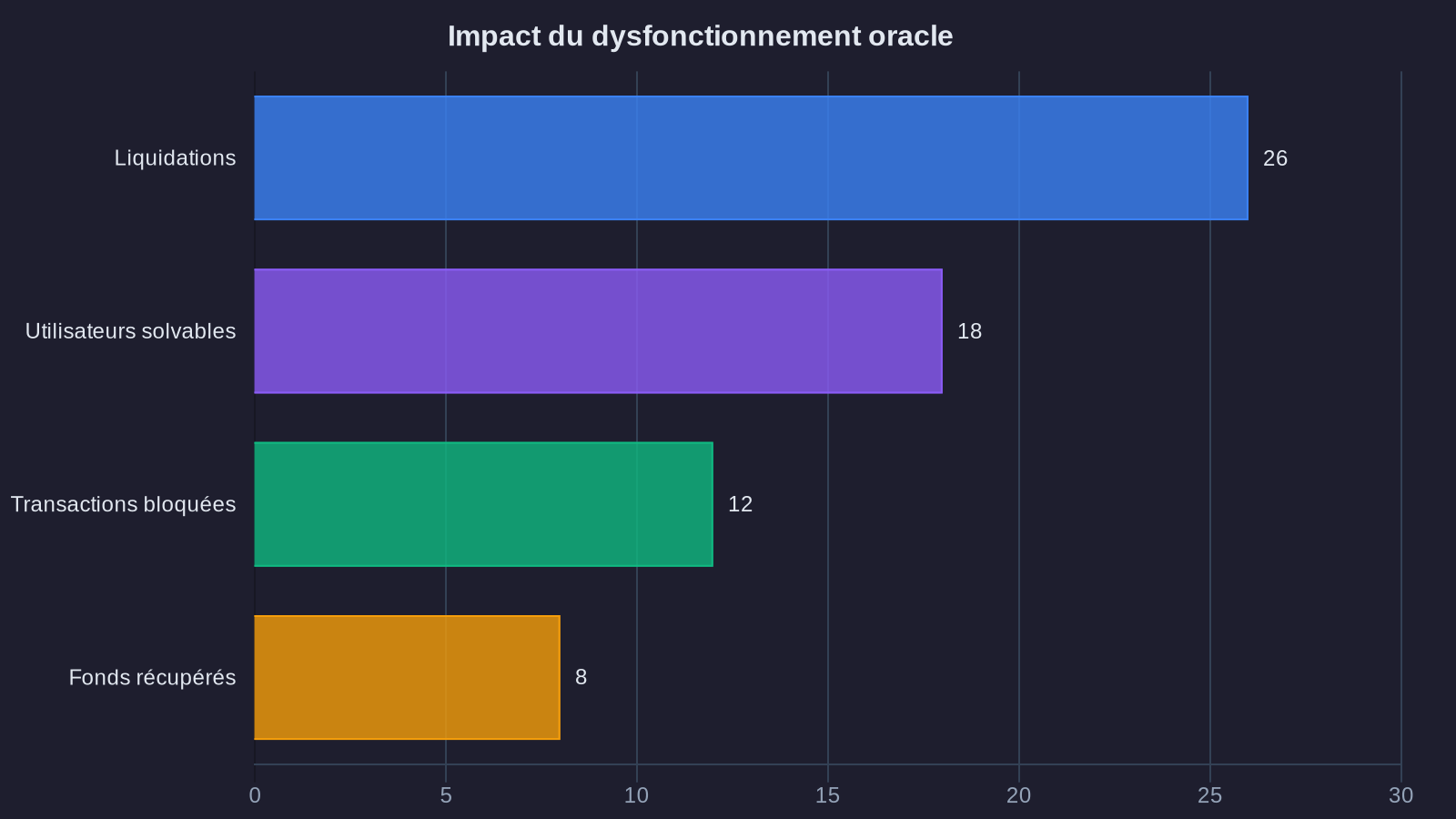
This type of incident reveals a fundamental paradox in DeFi. The protocol itself functioned exactly as designed: smart contracts executed the programmed rules, liquidations were processed in accordance with the code. The dysfunction originated from an external dependency—the oracle—whose reliability determines the integrity of the entire system. For an individual user or a company, this distinction offers no consolation: the loss is real, whether it stems from a bug in the protocol or an error in price reporting.
Cascade liquidations also amplify the damage. When many positions are liquidated simultaneously, liquidators sell the recovered assets en masse to realize their profit. This selling pressure can drive down prices on secondary markets, in turn triggering new liquidations on previously healthy positions. The system becomes self-reinforcing for minutes or hours, until prices stabilize or collateral is exhausted.
Existing protective mechanisms and their limitations
In response to this identified DeFi oracle risk, protocols have gradually implemented several layers of security. Since the November incident, Chainlink has strengthened its price validation mechanisms before transmission to smart contracts. Protocols like Aave now use multiple oracle sources in parallel, with anomaly detection rules. If an oracle provides a price that diverges significantly from other sources, the protocol can temporarily suspend liquidations or use a median price.
Some platforms are experimenting with "circuit breaker" systems, similar to those on traditional financial markets. When a sharp price movement is detected, liquidations are suspended for several minutes to verify whether the data is reliable or erroneous. This approach introduces a trade-off, however: by delaying legitimate liquidations during a genuine market crash, it can expose the protocol to insolvency risk.
From the user or company perspective, the most effective protection remains prudent collateralization ratio management. Maintaining collateral well above the minimum liquidation threshold creates a safety cushion that absorbs price variations, whether real or caused by an oracle error. Concretely, if a position with a 150% minimum collateralization is maintained at 200% or 250%, it can withstand a temporary 30% price error without triggering liquidation. This conservative approach mechanically reduces strategy returns, but constitutes the only protection truly under the borrower's control.
Implications for corporate cash allocation
For a chief financial officer evaluating the opportunity to use decentralized lending protocols, this incident recalls an essential reality: DeFi has not eliminated counterparty risk; it has transformed and redistributed it. Instead of depending on a bank's or centralized platform's solvency, the user depends on the technical reliability of a complex ecosystem of oracles, smart contracts, and automated mechanisms. This dependence is not necessarily riskier, but it demands a different analysis, particularly in terms of maximum risk measurement.
A cash surplus deposited on Aave or a similar protocol can generate attractive returns, exceeding traditional investments. However, this surplus should never be used as collateral to borrow other assets unless one explicitly accepts liquidation risk. A company depositing 500,000 euros equivalent in stablecoins on Aave to earn interest assumes smart contract risk and stablecoin depeg risk, but not oracle risk as long as it doesn't borrow. The situation becomes radically different if that same company uses its stablecoins as collateral to borrow ETH hoping to capture a price increase: it then exposes itself to liquidation risk, including oracle error risk.
The MiCA regulatory framework, which will be fully implemented during 2024, offers no particular protection against this type of technical incident. Decentralized protocols operate outside the scope of direct supervision by European regulators. In case of loss related to an oracle malfunction, there is no recourse or compensation mechanism equivalent to traditional banking guarantees. This reality must be incorporated into any allocation decision.
From a tax perspective, forced liquidations generate taxable events. If a French company is liquidated on Aave, the sale of its collateral constitutes a capital gain or loss taxable at the standard corporate tax rate. The loss incurred during liquidation can be deducted, but this only partially mitigates the actual financial impact. Accounting documentation of these transactions requires rigorous on-chain transaction traceability—an additional administrative complexity to anticipate.
A requirement for transparency and risk sizing
The November 11, 2023 incident on Aave did not undermine the viability of decentralized finance. Protocols continued to function, liquidity remained accessible, and governance mechanisms enabled rapid identification of the problem source. What was demonstrated, however, is that DeFi technical risks are neither anecdotal nor purely theoretical. They materialize regularly, with direct financial consequences for users.
For a company considering allocating part of its cash to these platforms, the recommendation is clear: strictly limit exposure to simple deposit strategies without leverage or collateralized borrowing. If a return of 3 to 5% annually on deposited stablecoins appears attractive compared to traditional cash investments, this return must be weighed against the risk of total capital loss in case of major technical failure. A reasonable allocation for an SME with 500,000 euros in excess cash might range from 5% to 10% maximum on established DeFi protocols, favoring simple deposits without use as collateral.
Using crypto collateral to borrow—whether to obtain stablecoin liquidity or to bet on an asset's price movement—constitutes a speculative strategy far beyond the scope of prudent corporate cash management. Incidents like that of November 2023 remind us that these strategies expose to sudden losses, difficult to anticipate and impossible to recover once realized. Oracle risk, combined with smart contract risks, underlying asset volatility, and absence of legal recourse, creates a risk profile incompatible with a company's capital preservation objectives for cash management.