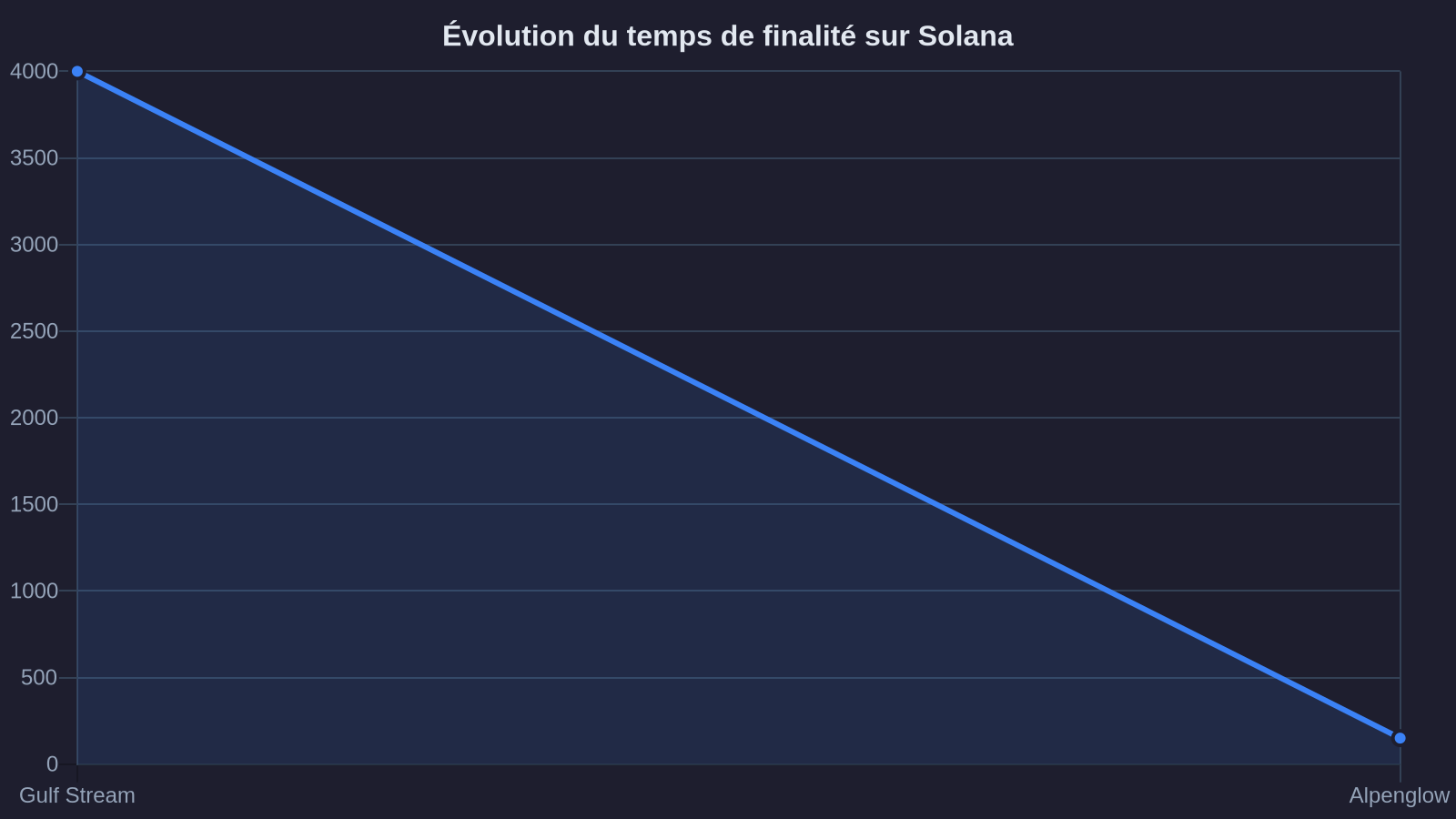
Solana deployed Alpenglow, its new consensus protocol, on March 12, 2026. The blockchain now finalizes transactions in 150 milliseconds versus 4 seconds previously. This isn't an incremental improvement: it's a structural shift that redefines what's possible on a public blockchain.
The numbers speak for themselves. A 96% reduction in finality time doesn't just affect users waiting for confirmation. It fundamentally reshapes arbitrage strategies, smart contract execution conditions, and risk models for lending protocols. When a transaction becomes irreversible in less time than it takes to blink, certain technical impossibilities suddenly become possible.
What changed technically in the consensus protocol
Alpenglow relies on a parallel voting mechanism that allows validators to confirm multiple blocks simultaneously, without waiting for sequential confirmation of the previous block. The previous protocol, Gulf Stream, pre-processed transactions but had to wait for each block to be finalized before moving to the next. Alpenglow decouples these two operations.
In practical terms: validators now vote on multiple blocks simultaneously, each with its own vote counter. As soon as a block reaches the required vote threshold (66% of total stake), it's finalized, regardless of the status of subsequent blocks. The protocol maintains up to 32 blocks in parallel, which allows it to absorb network latency variations without slowing down the entire chain.
Solana validators published their first post-deployment metrics on March 15. Across 10,000 consecutive blocks, 94% were finalized in less than 200 milliseconds. The remaining 6%, affected by network latency spikes, took between 200 and 400 milliseconds. No block exceeded 500 milliseconds. For comparison, before Alpenglow, 78% of blocks took between 3.8 and 4.2 seconds.
Impact on arbitrage strategies and trading latency
Arbitrageurs track price discrepancies between centralized and decentralized exchanges. When SOL trades at $142.50 on Binance and $142.80 on Orca (Solana's DEX), an opportunity exists—but only if you can execute both transactions before the spread closes. With 4 seconds of finality, much of these opportunities would disappear before confirmation. With 150 milliseconds, the window expands considerably.
Jump Trading, one of crypto's largest arbitrage firms, published a comparative study on March 17. Their algorithms now capture 43% more arbitrage opportunities on Solana compared to the pre-Alpenglow period. The average gain per trade remains modest (0.08% to 0.12%), but trading volume increased by 67%. Across millions of monthly transactions, the impact becomes significant.
This acceleration also shifts competitive dynamics. Smaller arbitrageurs without access to the ultra-low latency infrastructure of institutional market makers see their disadvantage shrink. When Solana finality becomes the limiting factor rather than server connection speed, competition rebalances. Early data shows a 28% increase in the number of unique addresses performing arbitrage on Solana since Alpenglow's deployment.
DeFi protocols adjust their parameters
Lending protocols like Solend and MarginFi must manage a perpetual risk: an borrower's collateral losing value before the protocol can liquidate their position. The longer finality is, the higher this risk. Protocols compensated by imposing high collateralization ratios—often 150% to 200% depending on assets.
Solend announced on March 16 an adjustment to its risk parameters. The minimum ratio for borrowing stablecoins against SOL dropped from 150% to 140%. On USDC, the optimal utilization rate (the point where rates begin climbing steeply) rose from 80% to 85%. These changes reflect a simple reality: with 26 times faster finality, the protocol can liquidate under-collateralized positions before they become toxic for the pool.
MarginFi's figures point in the same direction. The protocol recorded a 34% drop in partial liquidations (those affecting less than 50% of a position) since Alpenglow. Large liquidations remain stable: they're triggered by brutal market moves that far exceed the 150 millisecond finality window. But micro-liquidations—those caused by slight price slippage combined with slow finality—have virtually disappeared.
For users lending their assets, this translates to slightly adjusted yields. Rates on Solend fell by 0.3 to 0.5 percentage points depending on pools, a direct consequence of improved risk profile. Paradoxically, some protocols see their TVL (Total Value Locked) increase despite lower rates: the perception of enhanced safety attracts capital that previously stayed on the sidelines.
What the data shows after one week
Trading volume on Solana DEXs increased by 41% between March 12 and 18 compared to the previous week. Orca recorded $4.2 billion in volume, Raydium $3.8 billion. Part of this surge comes from general market volatility, but granular data shows a behavior shift: trades under $1,000 jumped by 89%, a sign that small arbitrages are becoming profitable.
Priority fees—the extra fees users pay to be included faster in a block—fell 23% on average. Before Alpenglow, paying more to get into the next block could save you up to 4 seconds. Now it saves at most 400 milliseconds. The incentive to overpay decreases, mechanically reducing fee pressure.
Validators also published their blockchain performance metrics. The rate of missed votes (when a validator fails to vote on a block within the allotted time) dropped from 2.1% to 0.7%. Alpenglow allows validators to recover more easily from temporary latency spikes without penalizing the entire network. Validators located in Asia-Pacific, historically disadvantaged by latency to primary clusters in North America and Europe, see their participation improve by 31%.
Limitations and risks to watch
Ultra-fast finality doesn't solve all problems. MEV attacks (Maximal Extractable Value), where bots reorder transactions to extract value, remain possible. They may even become potentially more profitable: a bot that can detect and exploit an opportunity in less than 150 milliseconds will capture more value than with a 4-second window where other actors have time to react.
Jito Labs, which develops anti-MEV solutions on Solana, observed a 52% increase in sandwich attack attempts (where a bot places an order before and after your transaction to profit from the price movement you create) since Alpenglow's deployment. Their protection infrastructure had to be adjusted to detect and block these attacks within a narrower time window. Wallet security vulnerabilities take on new dimensions in this accelerated environment.
Network decentralization also raises questions. Maintaining 150 millisecond finality requires high-performance validator infrastructure and quality network connectivity. Validators with older hardware or limited bandwidth struggle to keep pace. Since March 12, 14 validators (out of 1,847 active) have been temporarily excluded from consensus due to repeated missed votes. All were reintegrated after infrastructure upgrades, but this raises the question of entry costs for participating in consensus.
The Solana Foundation published technical guidelines on March 18 for validators: a server with minimum 512 GB RAM, 10 Gbps symmetric connection, latency below 50 milliseconds to at least 3 of the 5 primary clusters. These requirements raise the bar higher than before, potentially limiting geographic and economic diversity among validators. This infrastructure requirement underscores the importance of verifying the technical and financial strength of the platforms you interact with.
ForYield's take
Alpenglow modifies Solana's technical fundamentals in ways that directly impact DeFi yields and active management strategies. A 150 millisecond finality reduces counterparty risk on lending protocols, improves the efficiency of decentralized market makers, and opens new arbitrage opportunities for players who previously lacked access to this speed.
These technical changes translate into risk parameter adjustments that may seem minor—a collateralization ratio dropping by 10 points, an optimal utilization rate rising by 5 points—but which, aggregated across hundreds of millions of dollars in TVL, structurally modify targeted yields. Strategies that exploit these discrepancies require a deep understanding of consensus mechanisms and their implications for risk pricing.
ForYield integrates these developments into its DeFi protocol analysis. Finality speed is just one parameter among many, but it's one that changes the nature of what's possible on a blockchain. Monitoring how protocols adjust their risk models in response to these technical changes is part of our daily analytical work.
ForYield is pursuing PSCA approval from the AMF. DeFi strategies present capital loss risks linked to crypto-asset volatility, smart contract vulnerabilities, and protocol failures. No returns are guaranteed.