
You've held crypto assets for several months, maybe several years. They're sitting idle in your wallet. Meanwhile, those who chose staking are accumulating passive crypto income, month after month. The difference over three years? Between 12% and 45% additional tokens depending on the protocols.
Staking isn't a miracle product. It's a technical mechanism that secures Proof-of-Stake blockchains while generating passive income for holders. Unlike the triple-digit yield promises we saw in 2021, staking rates today reflect market maturity: between 4% and 15% annually depending on networks, with underlying asset volatility remaining the real variable at play.
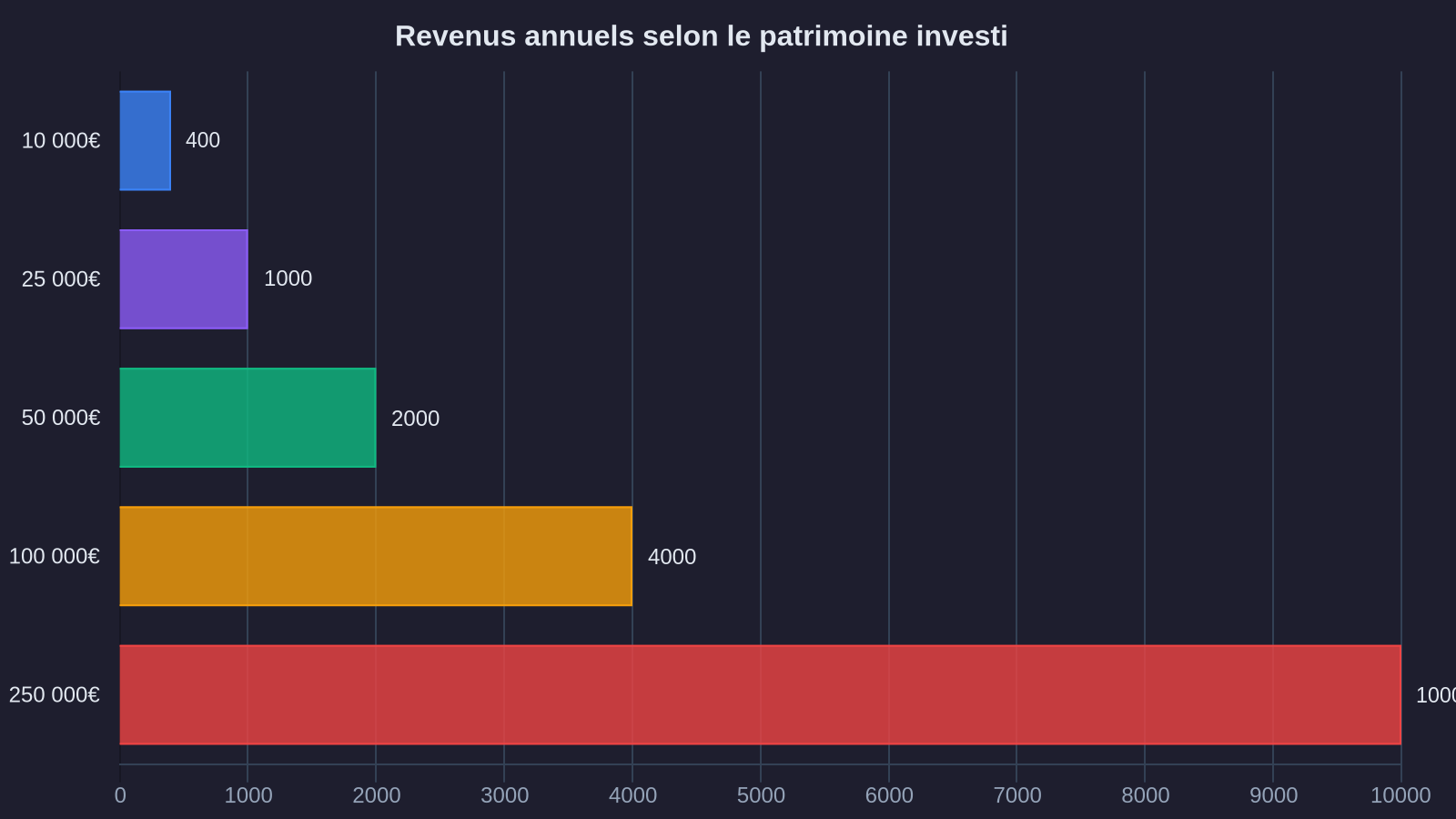
For a 50,000€ crypto portfolio, that translates to between 2,000€ and 7,500€ in annual staking rewards. But these figures say nothing about tax implications, liquidity risks, or optimization strategies that maximize accumulation. Because the differences are substantial depending on whether you stake on a centralized platform, delegate to a validator, or use liquid staking protocols.
How crypto asset staking actually works
Staking rests on a simple principle: lock up tokens to participate in securing a blockchain. In return, the network distributes rewards to holders who've blocked their assets. These blockchain staking rewards come from two sources: protocol monetary emission (programmed inflation) and transaction fees paid by users.
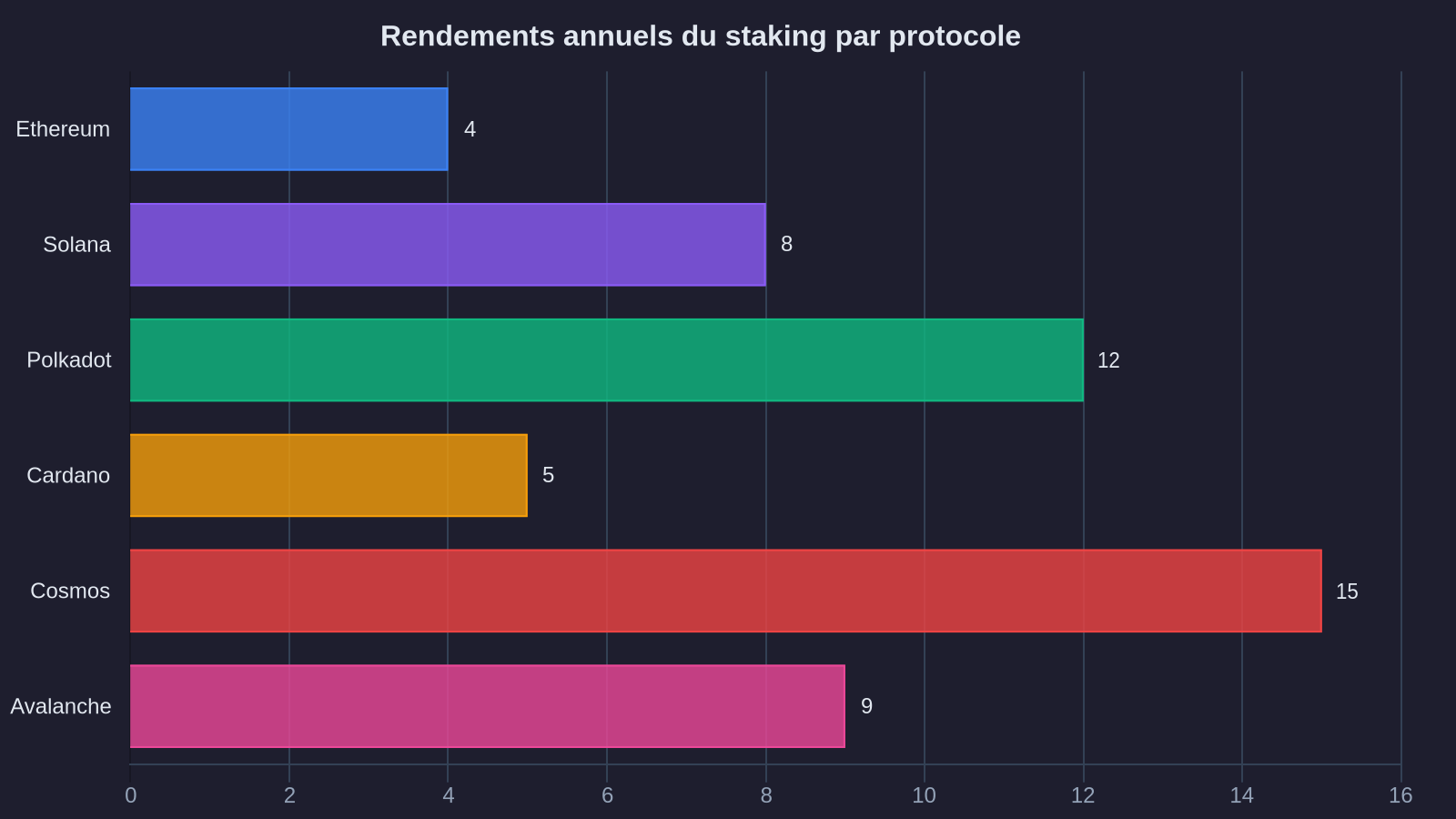
Take the example of Ethereum staking returns. Since the September 2022 merge, the network operates on Proof-of-Stake. To become a validator, you need to lock up 32 ETH (around 105,000€ at current rates). In return, the validator receives rewards oscillating between 3.5% and 5% annually, depending on network activity. For holders without 32 ETH, delegation allows participation in staking with any amount, subject to a commission charged by the service (typically between 10% and 25% of rewards).
On Cosmos, the mechanism differs slightly. ATOM staking generates roughly 18% annually, but part of this return comes from the network's monetary inflation. If you stake 1,000 ATOM today, you'll receive about 180 ATOM over a year. But in that time, the total ATOM supply will also increase. Your relative share of the network remains stable—it's your purchasing power in ATOM that grows.
The unlock period is a critical parameter often overlooked. On Ethereum, it's several days after activating a withdrawal request. On Solana, it reaches 2-3 epochs (roughly 2-3 days). On Cosmos, expect 21 days during which your tokens are locked without generating rewards. This liquidity constraint must be factored into your asset allocation.
Centralized vs. decentralized staking: a 2% to 5% net return difference
Centralized platforms like Coinbase, Kraken, or Binance offer turnkey staking. You deposit your tokens, the platform handles the technical side, and you receive rewards. Simplicity comes at a cost: these services charge between 15% and 25% of rewards. On Ethereum at 4% gross return, you net 3% to 3.4% after fees.
Decentralized staking, through your own wallet and direct validator selection, lets you keep all rewards or pay only 5% to 10% in commission. On the same Ethereum example, net returns climb to 3.6%-3.8%. The difference may seem marginal, but on 100,000€ staked over 5 years, it represents between 2,000€ and 4,000€ in gains.
The following table compares both approaches across three major networks:
| Network | Gross return | Centralized (net) | Decentralized (net) | Unlock period |
|---|---|---|---|---|
| Ethereum (ETH) | 4.0% | 3.0% - 3.4% | 3.6% - 3.8% | Variable (several days) |
| Solana (SOL) | 7.0% | 5.3% - 5.9% | 6.3% - 6.7% | 2-3 days |
| Cosmos (ATOM) | 18.0% | 13.5% - 15.3% | 16.2% - 17.1% | 21 days |
Decentralized staking requires a learning curve: installing a non-custodial wallet (Ledger Live, Phantom, Keplr), selecting a reliable validator (commission rates, uptime, reputation), and managing your private key security. For a crypto portfolio above 20,000€, the effort is well worth the gains.
The compounding effect: why automatic reinvestment changes everything
Most protocols distribute staking rewards daily or weekly. These rewards automatically add to your staked position, creating a compounding effect that maximizes passive DeFi accumulation. On Ethereum, if you stake 10 ETH at 4% annually, you won't receive 0.4 ETH at year-end, but slightly more thanks to daily reward compounding.
Let's run a concrete simulation over 5 years with an initial capital of 50,000€ (roughly 15 ETH at current rates):
- Without reinvestment: 50,000€ × 4% × 5 years = 10,000€ gross gains, or 60,000€ total
- With daily compounding: 50,000€ × (1.04)^5 = 60,833€, or 10,833€ gross gains
The 833€ difference may seem modest in this example. But it amplifies over time and capital amount. Over 10 years on 100,000€, the gap reaches 4,800€. Over 15 years, it exceeds 12,000€. This mechanism explains why certain long-term holders accumulate considerable positions without ever reinvesting fresh capital.
Liquid staking (Lido for Ethereum, Marinade for Solana) pushes the logic even further. You stake your ETH and receive stETH in return, representing your staked ETH plus accumulated rewards. These stETH can be used as collateral in DeFi protocols, allowing you to generate additional returns on already-staked tokens. This is called double yield: initial staking returns plus lending protocol returns on your stETH deposit.
This strategy obviously carries additional risks: smart contract risk, depeg risk between the staked asset and its liquid equivalent, and increased complexity. But for a savvy investor with significant crypto allocation, it can push effective returns from 4% to 7%-9% annually.
Optimizing your taxes and wealth management through staking
In France, staking rewards are taxed upon receipt, under the non-commercial income (BNC) category. Concretely, each reward received constitutes taxable income to declare. If you receive 0.5 ETH in rewards over the year, at an average rate of 3,300€, you declare 1,650€ in BNC.
This tax treatment poses a practical constraint: you must precisely track each reward distribution (date, amount, euro value at time of receipt). Tools like Waltio, Koinly, or CoinTracking automate this by connecting to your wallets and generating files necessary for tax filing.
The 30% flat tax (12.8% income tax + 17.2% social contributions) then applies to this income. If you received 4,000€ in rewards in 2026, you'll need to set aside 1,200€ for taxes. This deduction explains why some investors choose not to liquidate rewards immediately, but reinvest them in staking to keep them growing.
Wealth optimization rests on several levers. First lever: diversify staked networks to smooth returns and reduce concentration risk. A balanced allocation could be: 50% Ethereum (security, liquidity), 30% Solana (intermediate returns), 20% Cosmos or Polkadot (high returns, higher volatility).
Second lever: adjust the staked portion based on your investment horizon. For capital you don't plan to use for 3-5 years, an 80%-90% staking allocation is reasonable. For a liquidity reserve you might need within 6-12 months, limit staking to 30%-40% maximum, given unlock periods.
Third lever: balance returns against smart contract risk. Liquid staking or restaking protocols (like EigenLayer) offer superior returns but introduce layers of technical complexity. For a crypto portfolio above 100,000€, a prudent approach consists of staking 70% natively (directly on the blockchain) and 30% through DeFi protocols to optimize marginal returns. This profitability evaluation must be precise and quantified.
What this means for your crypto portfolio in 2026
Staking has become an essential building block of mature crypto allocation. Returns have normalized between 4% and 15%, in line with what you'd expect from a risky asset class. Underlying asset volatility remains the dominant factor: ETH up 50% far outweighs 4% staking, ETH down 40% makes rewards irrelevant.
But for long-term holders who view crypto assets as a sustainable asset class, ignoring staking means leaving 10%-15% in annual performance on the table. Over 5 years, the difference between a staked and non-staked portfolio exceeds 25% additional capital. Over 10 years, it approaches 60%.
The choice between centralized platform and decentralized staking depends on your technical comfort level and amount at stake. Below 10,000€, centralized platform simplicity probably wins. Above 20,000€, the effort to learn decentralized staking becomes worthwhile. Above 50,000€, failing to optimize your staking fees constitutes a measurable wealth management mistake.
The challenge ahead will be integrating these staking flows into true wealth management: tax provisions, strategic reward reinvestment, protocol diversification, and above all, discipline to never confuse nominal return with real performance after inflation and taxes. The 15% displayed on Cosmos only counts if you actually capture it, the network stays secure, and monetary dilution doesn't offset your accumulation.
Your wealth deserves better than a savings account. I'll show you the way, with numbers to back it up.