In January 2025, the New York Stock Exchange announced a partnership with Avalanche to develop an infrastructure for tokenizing equities. This alliance between the world's leading stock exchange and a next-generation blockchain marks a turning point: traditional finance is no longer merely observing blockchain technology—it's integrating it into its architecture.
To understand what's at stake, we need to return to a simple question: why would Wall Street, after decades of perfectly functional centralized systems, choose to tokenize its equities? The answer isn't about technological hype, but rather structural challenges around costs, settlement speed, and market access.
Why the NYSE chose Avalanche over a private infrastructure
The New York Stock Exchange already has robust clearing infrastructure. Transactions execute in milliseconds, and the T+1 system (settlement-delivery within one business day) has been operating since May 2024. So why a public blockchain?
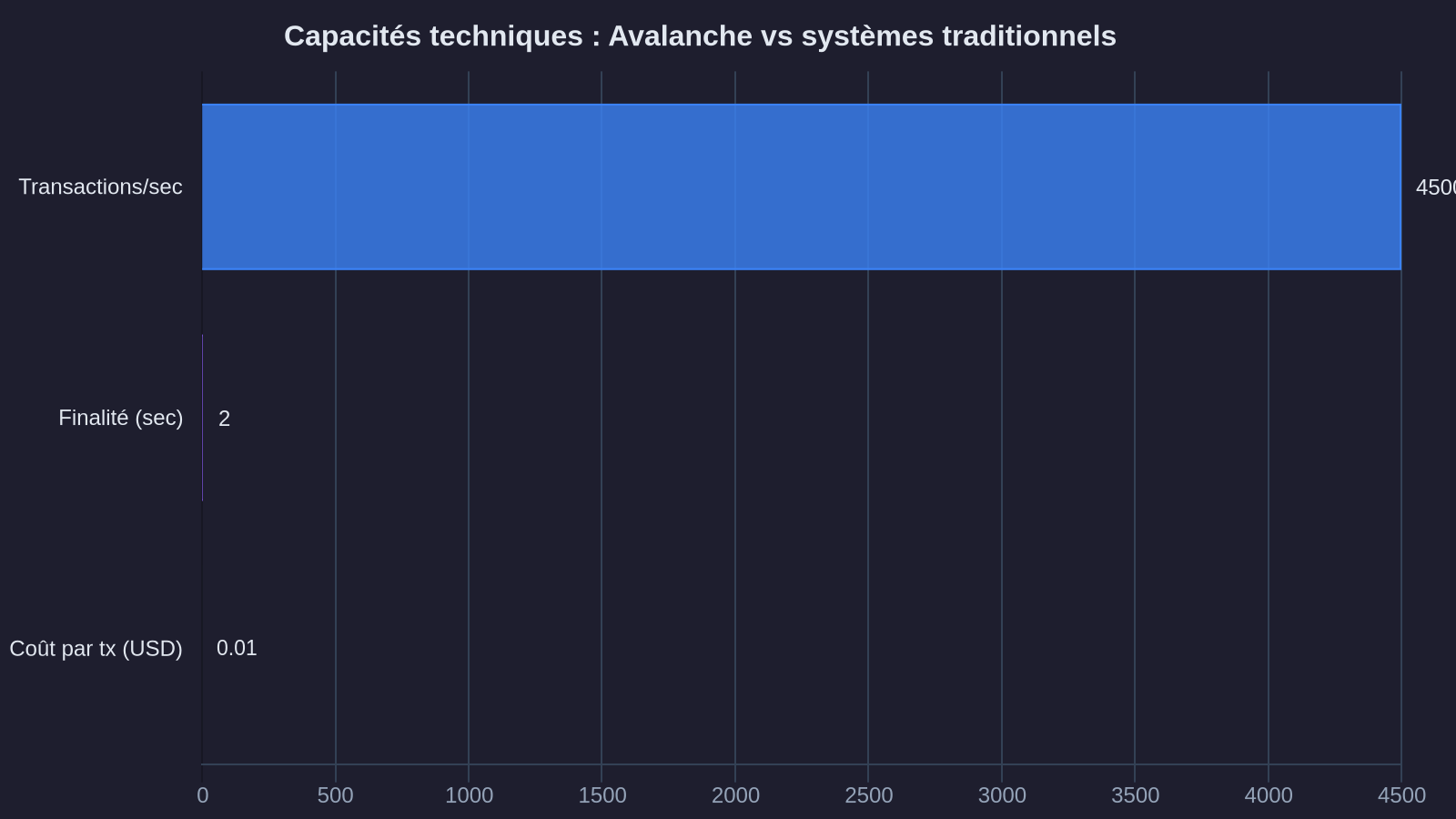
Avalanche presents three characteristics that appeal to institutional players. First, processing capacity: the network can handle over 4,500 transactions per second, with finality in less than two seconds. Second, the subnet architecture allows creating isolated environments governed by specific rules while still benefiting from the main network's security. Finally, compatibility with the Ethereum Virtual Machine (EVM) facilitates integration of third-party applications.
This infrastructure opens a possibility that centralized systems cannot offer: instant settlement 24/7, without a clearing intermediary. On a blockchain, transaction and settlement are one and the same. This reduces counterparty risk, back-office costs, and delays in capital availability.
A concrete example: today, if you sell a stock on Friday afternoon, you receive your money on Monday. With a tokenized infrastructure, settlement would be instantaneous, even on a Sunday at 3 a.m. This permanent capital availability changes the game for investors arbitraging between multiple asset classes.
NYSE equity tokenization on Avalanche: what it means for retail investors
Tokenization consists of representing a financial asset as a digital token on a blockchain. Each token corresponds to a fraction or entire equity, with the same economic rights (dividends) and voting rights as a traditional share. The difference lies in how the asset is recorded, transferred, and divided.
For individual investors, three concrete implications deserve attention.
Fractional ownership becomes native with tokenized securities
Today, if you want to buy a fraction of an Amazon share (trading around $200), you go through a broker who holds the entire share and allocates you a portion. You don't own it on the register—the broker does. With tokenization, fractional ownership is recorded directly on the blockchain: you hold 0.1 Amazon token, and that token is registered to your address.
This difference isn't merely administrative. It opens the door to operations impossible today: using your fractional share as collateral in a lending protocol, transferring it directly to a third party without a broker, or combining it with other tokenized assets in a single interface.
Transaction fees decline structurally
A transaction on Avalanche costs a fraction of a cent. Compare this to brokerage fees, bid-ask spreads, and traditional clearing costs. For an investor practicing dollar-cost averaging (regular small investments), the difference is significant. Investing €50 every Monday becomes economically viable, whereas today fixed fees make this strategy impractical.
Be careful, however: blockchain fees are only part of the total cost. Platforms offering access to these tokenized equities will charge their own service fees. The gain depends on their business model.
Market access becomes global and continuous
A tokenized share on Avalanche can be traded outside NYSE hours, between actors in different time zones. This creates a continuous secondary market, similar to what already exists for crypto-assets. For an investor in Europe or Asia, this means being able to react to earnings announcements without waiting for Wall Street to open.
But this continuity has a downside: liquidity can fragment between the primary market and secondary tokenized markets. During high volatility, price gaps between the two environments can create arbitrage opportunities, but also risks of dislocation. This situation echoes issues discussed in our analysis on migration to decentralized exchanges.
Risks this TradFi-DeFi convergence doesn't resolve
Tokenizing equities on Avalanche doesn't transform Wall Street into a lawless playground. The regulatory framework remains unchanged: these tokenized equities remain financial securities, subject to the same reporting, tax, and compliance obligations as traditional shares.
Asset custody remains a critical point
Holding a token on a blockchain doesn't mean directly holding the underlying share. You need a regulated intermediary ensuring the correspondence between the token and the share registered in the NYSE registry. This intermediary, called a regulated custodian, must guarantee that each token issued corresponds to a share properly held and segregated.
If this custodian fails, or if a discrepancy emerges between circulating tokens and held shares, the investor faces classic counterparty risk despite the blockchain infrastructure. The blockchain's transparency lets you verify token issuance in real time, but it doesn't guarantee the underlying shares exist and are properly isolated. The protective mechanisms around segregated holdings deserve particular attention.
Taxation doesn't disappear behind the technology
Each token transfer constitutes a taxable event. In France, capital gains on tokenized shares follow the same regime as traditional shares: a flat 30% tax or progressive income tax rates, depending on your choice. Dividends remain taxed the same way.
The difficulty lies in tracking: if you transfer your tokens between multiple blockchain wallets, use them as collateral, or exchange them for other tokenized assets, each operation must be documented. Tax reconciliation tools will need to evolve, as tax software publishers aren't yet equipped to track these movements.
DeFi protocol regulation remains unclear
If tomorrow a decentralized lending protocol accepts NYSE tokenized equities as collateral, who oversees it? The AMF, the SEC, the CFTC? The question remains unanswered. Jurisdictions overlap, and liability in case of smart contract failure or market manipulation is uncertain.
This gray area won't disappear with the NYSE's arrival on Avalanche. Rather, it expands: the more traditional assets migrate to decentralized infrastructure, the more regulators must determine the legal nature of protocols, tokens, and intermediaries.
What this means for your wealth
The NYSE-Avalanche partnership announcement isn't a buy signal or an overnight revolution. It's a step in a convergence process between two worlds that, until now, evolved in parallel. Traditional finance brings depth, liquidity, and regulatory framework. Blockchain brings transparency, settlement speed, and asset composability.
For investors, three questions arise before any decision.
First question: who custodies your assets, and how is this custody guaranteed? Verify the regulated custodian's status, segregation of assets, and protections in case of failure. A token on a blockchain doesn't replace a regulated depository.
Second question: what is the total cost of ownership, beyond blockchain transaction fees? Factor in platform fees, spreads, conversion costs between euros and cryptocurrencies if needed, and potential withdrawal or transfer fees.
Third question: how do you document your operations for tax reporting? If the platform doesn't generate an IFU (tax statement form) or history compatible with your tax software, you'll have to manually reconstruct each movement. This time has a cost.
Tokenizing equities on Avalanche opens new possibilities: fractional access, instant settlement, integration with other digital assets. But it eliminates neither the risk of capital loss nor the need to understand what you truly own. Your capital remains exposed to the same market fluctuations as a traditional share, with additional layers of risk related to technology, custody, and regulation.
Before acting, ask yourself this: do I understand the mechanism, the fees, the risks, and how my assets are protected? If the answer isn't clear, that's the moment to find it—not to invest.
Understand before deciding: it's the only rule twenty-five years of private wealth management have taught me. Invested capital remains exposed to loss risk, and this article does not constitute investment advice.