
On April 18, 2025, two DeFi protocols suffered massive exploits within hours of each other. Resolv Protocol lost $24 million, Venus Protocol $3.7 million. These figures tell only part of the story. The real question isn't "why these protocols" but "why do these smart contract vulnerabilities persist in an ecosystem that claims to have learned from its mistakes".
These two attacks reveal an undeniable reality: DeFi presents structural risks that neither DeFi security audits nor decentralized insurance can completely eliminate. For investors exposed to these protocols, understanding the precise mechanics of these exploits isn't optional. It's a necessity.
The anatomy of a DeFi exploit: the Resolv Protocol case
Resolv Protocol offered an algorithmic stablecoin with a collateralization mechanism. On April 18 at 3:47 AM UTC, an attacker identified a critical flaw in the price oracle validation function. The protocol used an aggregated price system from multiple sources, but the verification logic contained an exploitable race condition.
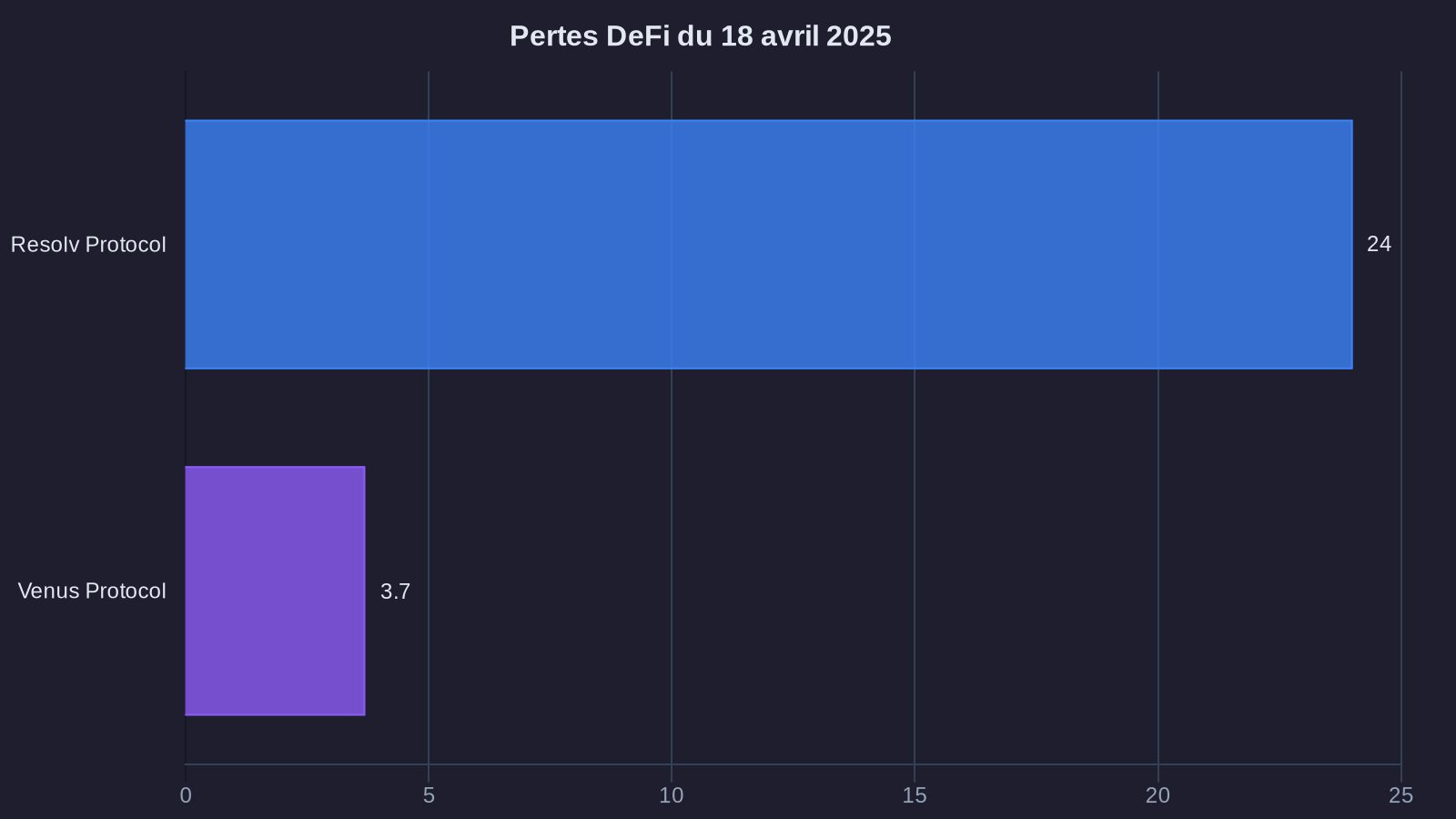
In concrete terms, the attacker proceeded in three stages. First, they took out a flash loan of 50,000 ETH on Aave, worth approximately $150 million at the time. Next, they manipulated the Uniswap V3 liquidity pool linked to Resolv's token by executing a massive swap that temporarily skewed the price ratio. Finally, in the same Ethereum block, they called the stablecoin mint function at the exact moment the oracle was reading this artificially inflated price.
The protocol validated the transaction by accepting undervalued collateralization. The attacker thus minted $24 million in stablecoins while depositing only a fraction of the actual required value. They immediately converted these tokens to ETH, repaid their flash loan, and transferred the funds to a mixer. Total operation duration: 13 seconds.
This type of attack is technically called "oracle manipulation via price impact". It's not new. Protocols like bZx in 2020 or Mango Markets in 2022 suffered similar exploits. What's specific here is that Resolv had been audited by two recognized firms just six months before the incident. A situation reminiscent of other massive DeFi exploits where audited protocols were compromised.
Venus Protocol: when a logic flaw bypasses safeguards
Venus Protocol, a decentralized lending platform on BNB Chain, presented a different risk profile. The exploit didn't stem from oracle manipulation but from a vulnerability in the liquidation function for under-collateralized positions.
The protocol allows users to deposit assets as collateral and borrow other tokens. When the collateralization ratio falls below a critical threshold (typically 110-120%), any user can liquidate the position and claim a bonus, usually 5 to 8% of the liquidated value. This mechanism protects the protocol against defaults.
The attacker identified a flaw in the liquidation bonus calculation logic. By exploiting an edge case condition in the smart contract, they could trigger liquidations on technically sound positions while capturing an artificially inflated liquidation bonus. The code didn't properly verify the position's state before authorizing liquidation in certain specific circumstances involving tokens with non-standard decimals.
The exploit drained $3.7 million in USDT and USDC before the Venus team paused the protocol. Unlike Resolv, Venus was able to partially freeze funds and recover approximately $800,000 through collaboration with BNB Chain validators. The rest is lost.
What stands out here is that this vulnerability affected a fundamental component tested for years. Venus is a fork of Compound Finance, one of the most audited protocols in the ecosystem. The modification introduced when adapting to BNB Chain created the flaw. A single change among thousands of lines of code was enough.
Why DeFi security audits aren't sufficient
Resolv was audited by Trail of Bits and Quantstamp. Venus relied on Compound's code, which has been verified by dozens of audits since 2018. Yet both were exploited. This reality raises a fundamental question: what is a smart contract security audit really worth?
A security audit verifies that the code does what it claims to do under normal usage conditions. It identifies known vulnerabilities: reentrancy, integer overflow, unauthorized access issues. What an audit cannot guarantee is exhaustiveness. Auditors test scenarios, not all possible scenarios. A complex protocol with 15,000 lines of Solidity has billions of potential execution paths.
Sophisticated exploits like those of Resolv and Venus exploit interactions between multiple components under edge case conditions that standard audits don't systematically cover. The Resolv attacker, for example, combined price manipulation on Uniswap with precise function call timing in the same block. This specific sequence likely wasn't in the auditors' test scope.
Another aggravating factor: protocols evolve. After the initial audit, updates are deployed, sometimes without a complete new audit. Venus modified its code to adapt to BNB Chain. These incremental changes, deemed minor, introduced the vulnerability.
Economic incentives must also be considered. An auditor is paid to deliver a report within a defined timeframe. Finding all possible vulnerabilities would require time and budget that few protocols are willing to allocate. Standard audits cost between $50,000 and $200,000 and last 3 to 6 weeks. An exhaustive audit with formal verification and intensive fuzzing could take 6 months and cost several million dollars.
Protocol risk management: key vigilance points to protect your capital
Facing these structural risks, how do you assess a protocol's real security before deploying capital? Several indicators can help refine your risk analysis and optimize your protocol risk management.
First criterion: protocol maturity. A smart contract that has been running for three years without major incidents has statistically weathered the test of time. Critical vulnerabilities are generally exploited within the first six months. Venus existed since 2020, but its latest modification was just a few months old. This recent version is what was compromised. A mature protocol with recent modifications presents a risk profile close to a new protocol.
Second criterion: quality and diversity of audits. A single audit, even by a reputable firm, offers only partial coverage. Serious protocols commission multiple independent audits from different firms. Each auditing team brings specific methodology and expertise. Systematically review public audit reports and verify that critical and high-severity issues were resolved before deployment.
Third criterion: presence of an active bug bounty program. Reward programs for vulnerability discovery mobilize a community of security researchers who continuously test the protocol. Immunefi, the leading crypto bug bounty platform, lists maximum payable amounts. A protocol offering $500,000 or more for a critical vulnerability demonstrates genuine financial commitment to its security. Also check the history: how many bugs have been found and fixed through the program?
Fourth criterion: team transparency and incident response speed. When an incident occurs, how does the team communicate? Venus published a detailed post-mortem within 48 hours, including complete technical analysis of the exploit. Resolv took three days to communicate clearly. This difference often reflects the team's level of preparedness and professionalism. A protocol with a well-defined incident response plan limits damage.
Fifth criterion: defensive security architecture. Robust protocols implement defense-in-depth mechanisms. Time locks on critical parameter modifications, multisig for governance, daily withdrawal limits, circuit breakers that automatically pause the protocol if anomalies are detected. These safeguards don't prevent all exploits but significantly reduce attack surface.
The key vigilance point: No DeFi protocol can guarantee absolute security. The question isn't "is this protocol safe" but "what level of risk am I willing to accept for the offered returns". A 25% APY on a three-month-old protocol mechanically incorporates exploit risk far higher than a 4% return on Aave, a protocol that has been running since 2017 with billions in TVL without major incidents. Always adjust your allocation based on this risk/return ratio, just as you would when evaluating your portfolio's drawdown.
Investor responsibility in the DeFi ecosystem
These $27.7 million in losses raise a broader question about responsibility. Who should bear the risk of exploits? Users who chose to deploy their capital on these protocols? Developers who coded the smart contracts? Auditors who validated security?
Legally, the answer is complex. DeFi protocols generally operate through decentralized structures without a clear legal entity. Terms of service systematically state that users accept the risk of total loss. No recourse is possible in most jurisdictions. Unlike centralized platforms like exchanges, where you can theoretically sue the company for negligence, an exploited smart contract leaves no path to recovery.
This reality implies increased responsibility for the investor. In traditional finance, regulators verify institutional soundness before granting them a license. In DeFi, this due diligence falls entirely on you. Deploying €50,000 to a protocol without reading audits, verifying source code, or analyzing governance mechanisms is essentially signing a blank check.
Some protocols offer decentralized insurance through platforms like Nexus Mutual or InsurAce. These products partially cover exploit risk, for an annual premium of 2 to 5% of insured capital. Coverage is never complete and trigger conditions are strictly defined. For significant capital exposed to risky protocols, this insurance represents a reasonable cost.
Toward progressive ecosystem maturity
Despite these recurring incidents, DeFi is progressing. The 2025 exploits are more sophisticated than those of 2020, which means trivial vulnerabilities have largely been eliminated. Attackers today must combine multiple attack vectors and exploit complex edge cases. This rising complexity demonstrates gradual improvement in security standards.
Initiatives are emerging to professionalize smart contract auditing. Firms like Trail of Bits are developing formal verification tools that mathematically prove certain code properties. These methods remain costly and time-consuming, but are gradually becoming the standard for protocols managing hundreds of millions of dollars.
Regulation is also beginning to shape the ecosystem. The European MiCA regulation, applicable since January 2025, imposes security requirements on crypto asset service providers. These obligations include regular audits, incident response plans, and capital reserves to cover operational losses. Purely decentralized protocols still escape this regulation, but pressure is intensifying to establish minimum standards.
For institutional investors and family offices we advise, these developments are decisive. DeFi cannot remain an unregulated frontier if it aspires to capture significant traditional capital volumes. The Resolv and Venus exploits brutally remind us of this reality: without robust and verifiable security standards, DeFi will remain confined to a market segment accepting extreme risks.
At ForYield, our protocol selection approach systematically integrates these security criteria before any allocation recommendation. A protocol that doesn't meet our minimum requirements in terms of audit, maturity, and defensive architecture doesn't enter our strategies, regardless of offered returns. Capital preservation always takes priority over raw performance. In an ecosystem where $27.7 million can disappear in hours, this discipline is non-negotiable.