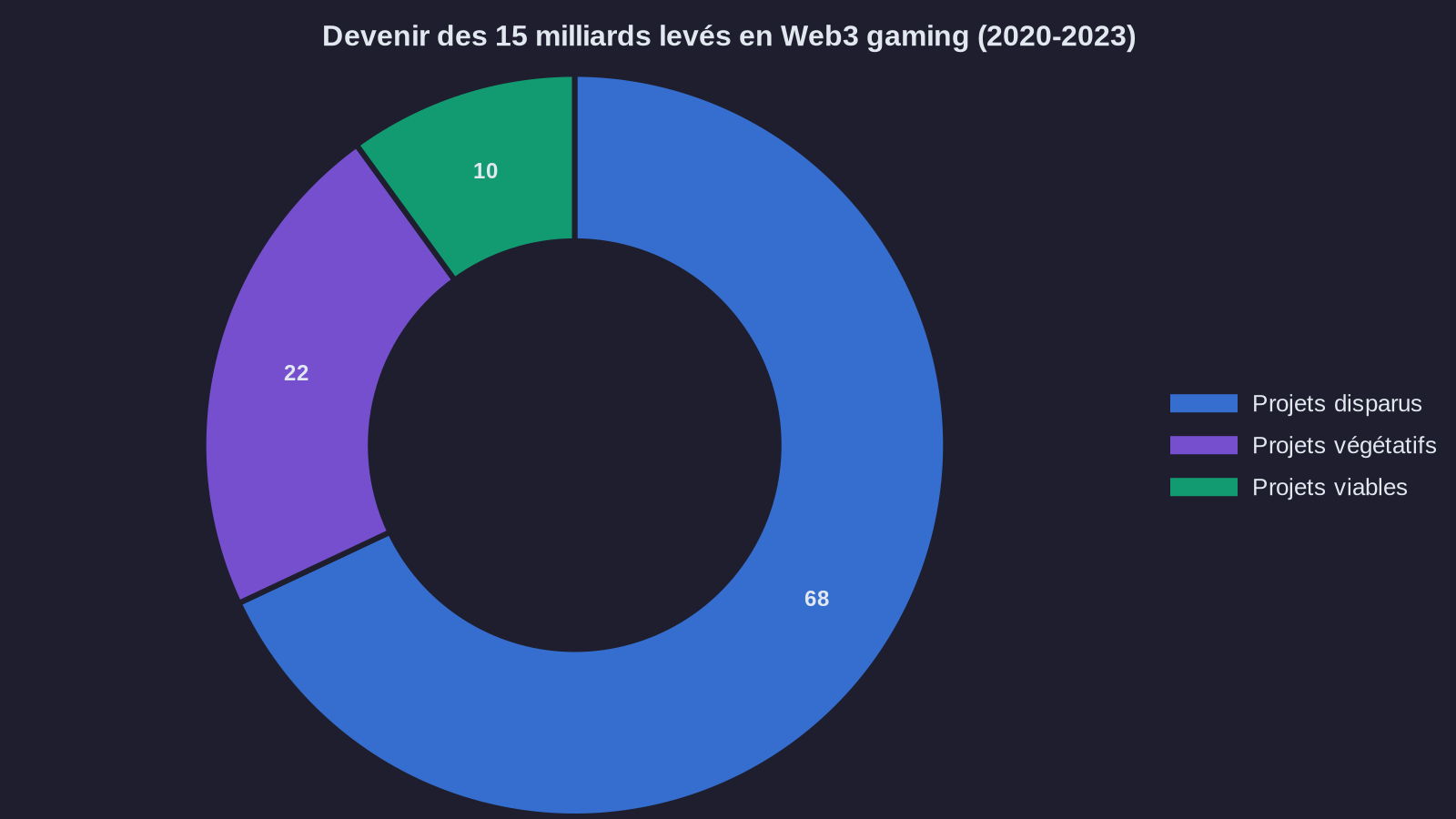
Between 2020 and 2023, the Web3 gaming sector raised over $15 billion. Three years later, 90% of these projects have disappeared or are barely surviving with a few hundred active users. No players, no liquidity, no community. An industrial disaster whose scale far exceeds a simple speculative bubble burst — a failure that underscores the importance of rethinking sustainable yield strategies across the crypto ecosystem.
Crypto didn't kill Web3 gaming. It was the overlooking of a fundamental principle: a game must first and foremost be fun. The story of this collapse reveals crucial lessons for anyone interested in the intersection between blockchain and user experience, particularly regarding Web3 player adoption.
The fundamental mistake: confusing financial mechanics with game design
Imagine being offered a Monopoly game where every square generates real money. Tempting? Perhaps. But is it still a game, or simply an enrichment mechanism disguised as entertainment?
The vast majority of blockchain games made this mistake. They designed sophisticated economic systems – multi-tiered tokenomics, evolving NFTs, integrated staking mechanisms – without asking the essential question: why would anyone spend time here if money wasn't involved?
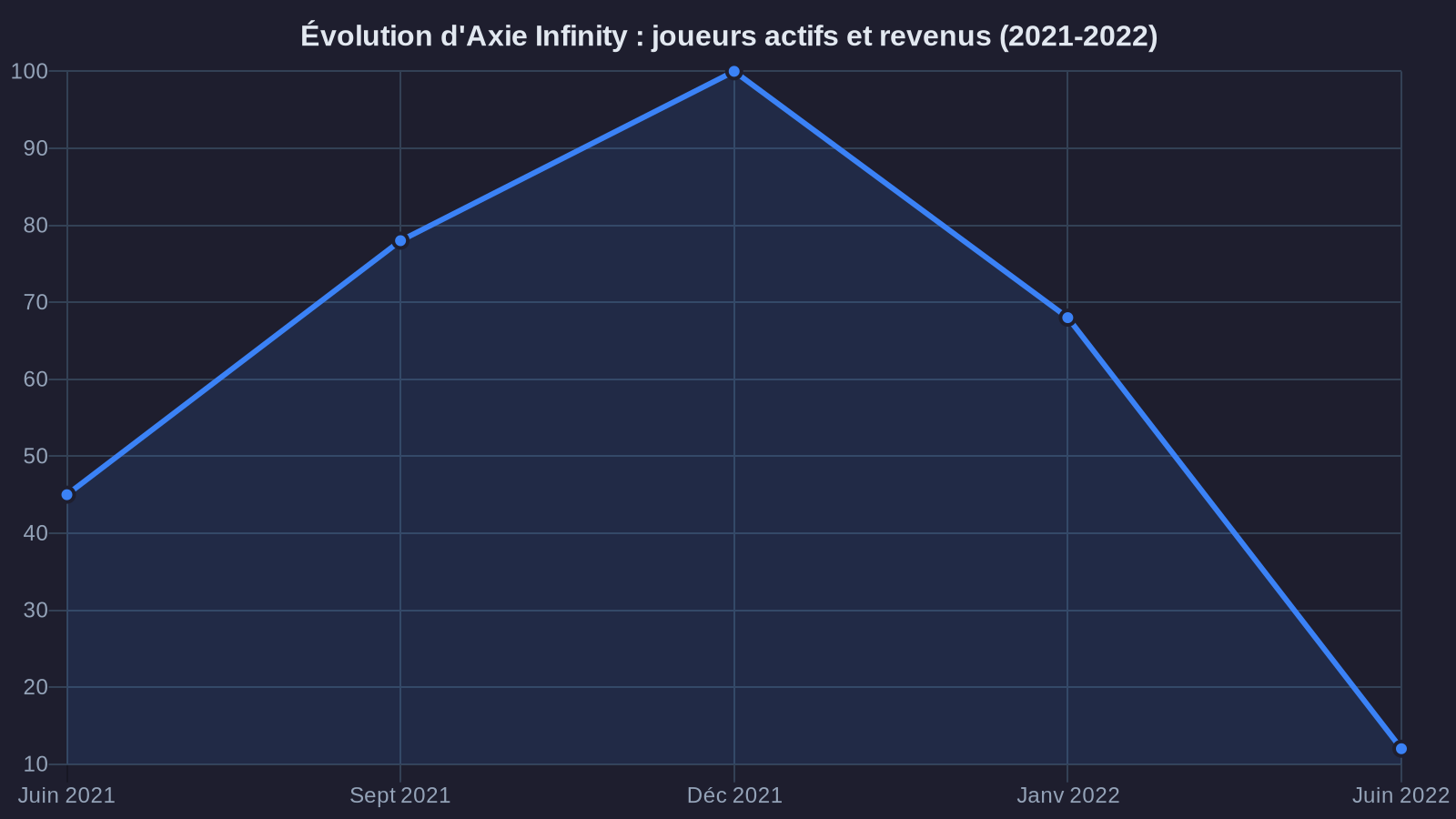
Take Axie Infinity, the sector's flagship project. At its peak in late 2021, the game generated $1.3 billion in annual revenue. Six months later, collapse: 90% of players gone, token in freefall. The reason? Axie was never a game. It was a pyramid yield system dressed up as Pokémon. When new entrants dried up, the mechanism broke down.
Development teams spent 80% of their energy on game economics, 20% on gameplay. They should have inverted those proportions. A good game can do without blockchain. Blockchain can't compensate for a mediocre game.
The play-to-earn trap: when speculation replaces playability
The term "play-to-earn" itself contains the seeds of the sector's failure. We don't say "read-to-earn" or "watch-a-movie-to-get-paid." Entertainment exists for its own sake, not as a means to enrichment.
In reality, play-to-earn created an economy of disguised labor. In the Philippines, Venezuela, players were spending 8 hours a day farming resources in Axie Infinity to earn the equivalent of local minimum wage. Guilds organized themselves, lending NFTs in exchange for a cut of earnings. It was closer to microwork than entertainment.
This dynamic produced a perverse effect: players optimized for returns, not enjoyment. They sought the most profitable mechanics, not the most fun ones. Developers responded by constantly adjusting rewards, creating a vicious cycle where nobody was actually playing.
When the crypto market turned in 2022, reality hit hard. Without prospect of gains, why continue playing a mediocre game? Players left en masse, revealing that these projects had never built genuine gaming engagement — a dynamic similar to the systemic risks that destabilize poorly designed crypto ecosystems.
Tokenomics as a band-aid on a wooden leg
Faced with player exodus, many projects responded by complicating their economy. Dual-token systems, burning mechanisms, vesting periods… Complex contraptions meant to "stabilize" the game's economy.
It's like trying to fix a car with no engine by repainting the body. Gaming token mechanics can't create value where there's no actual use value. If your game isn't fun, no financial mechanism will save it.
Technical errors that amplified the disaster
Beyond failed game design, technical choices added an insurmountable layer of friction for traditional players, undermining any chance of large-scale Web3 player adoption.
First, onboarding. To play most blockchain games in 2022, you had to: create a crypto wallet, buy ETH or BNB, pay gas fees to mint starter NFTs, understand what a seed phrase is… An obstacle course that discouraged 95% of potential players before they even saw the game.
Imagine having to open a Swiss bank account and learn cryptography just to launch Fortnite. Absurd, right? Yet that's what we asked players to do.
Next, performance. Many games ran directly on-chain, with every action validated by a blockchain transaction. Result: unbearable latency, prohibitive costs, degraded experience. They tried running real-time action games on infrastructure designed for financial transaction validation.
Solutions exist today – layer 2, sidechains, hybrid models – but they arrived too late for the first generation of projects. The sector paid the price for its technical impatience.
What could have worked: possible pivots
Not all blockchain games failed. A handful of projects are succeeding by returning to fundamentals and prioritizing playability over speculation.
Build a real game first, add blockchain second. Projects like Illuvium and Gods Unchained invested heavily in gameplay before thinking about tokenomics. They're building games that could exist without blockchain, then use NFTs to add real value (true asset ownership, functional secondary markets) rather than artificially create engagement.
Target use cases where blockchain actually adds something. Collectible games, TCGs (Trading Card Games), persistent worlds where ownership truly matters. Not action games or casual games where blockchain adds nothing to the experience.
Abandon play-to-earn for "play-and-own." A subtle but crucial distinction. The goal isn't to compensate time spent, but to let players truly own their acquisitions and trade them freely. We're back to a collection logic, not disguised employment.
Some projects are experimenting with interesting hybrid models: the bulk of the game runs off-chain for performance reasons, only valuable assets (rare equipment, land, characters) are tokenized. It's a pragmatic compromise that prioritizes user experience.
Lessons for the future: toward mature Web3 gaming in 2025
The failure of Web3 gaming version 2021-2023 isn't the end of the story. It's the end of the beginning. The sector paid the price for its arrogance and haste. What's emerging now looks more like a mature industry.
First lesson: technology doesn't create demand. A mediocre game with NFTs is still a mediocre game. Blockchain is a tool, not a strategy. Projects that succeed will be those that first build solid gaming experiences, then strategically use blockchain where it adds real value.
Second lesson: players aren't investors. They want to have fun, not optimize returns. A game's business model should flow from its gameplay, not the other way around. Monetization must be invisible or desirable, never a requirement for progress.
Third lesson: infrastructure matters. You can't build mass-market experiences on inadequate technical foundations. Scalability solutions, wallet abstractions, meta-transactions… everything that reduces friction must be a priority.
The $15 billion invested wasn't entirely wasted. It funded painful but necessary learning. The traditional video game industry took 40 years to reach its current maturity. Web3 gaming just went through its first real crisis. It's now up to the next generation of builders to do better, keeping in mind a simple truth: before they're financial products, games must first be games.
```