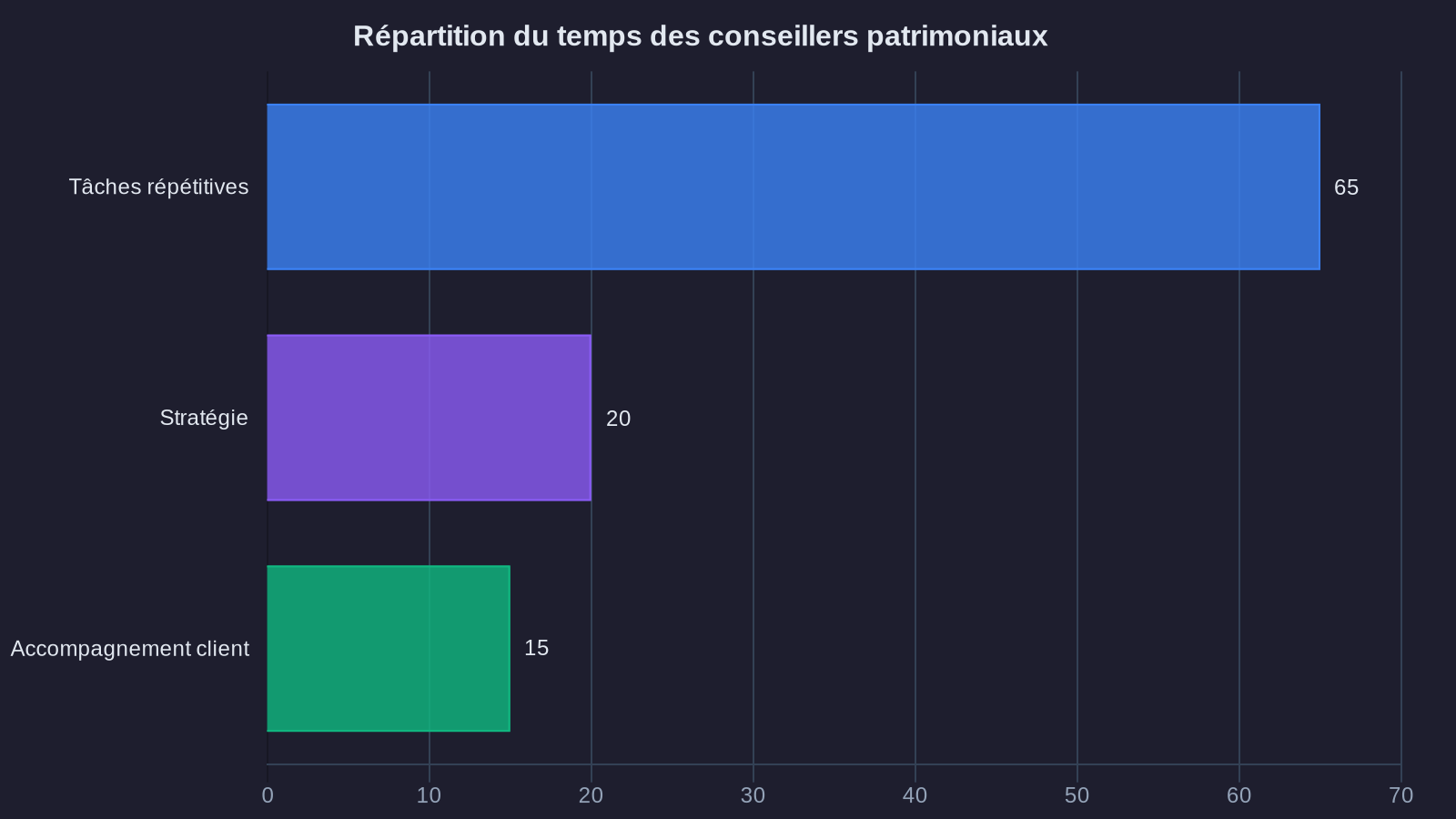
In 2026, a wealth manager manually analyzing each quarterly report, every market movement, and each allocation opportunity would spend their days collecting data rather than making decisions. This is exactly what happens in many firms: wealth advisors spend 60 to 70% of their time on repetitive analysis tasks, at the expense of strategy and client engagement.
AI agents for investment pipeline automation — autonomous programs capable of executing complex workflows without human intervention — are changing the game. Not by replacing human judgment, but by automating the analysis and allocation pipelines that have historically consumed considerable time. The difference between a firm that integrates these tools and one that sticks with manual processes? A competitive advantage of several weeks in decision-making.
What an AI agent really does in an investment process
An AI agent is not a chatbot that answers your questions. It's a system that executes sequential tasks autonomously, following defined rules and adapting to context. In investment, this means it can orchestrate a complete pipeline: retrieving market data, cleaning it, calculating indicators, detecting anomalies, generating allocation recommendations, and even executing orders on compatible platforms.
Let's take a concrete example. You manage a diversified portfolio with a target allocation of 60% stocks, 30% bonds, 10% crypto assets. Every week, markets move. Your allocation drifts. An AI agent can monitor this drift in real time, calculate deviations from your strategic allocation, and propose — or automatically execute, depending on your settings — the necessary rebalancing orders. What once took two hours of manual analysis each week becomes a continuous, frictionless process.
The benefit isn't limited to rebalancing. An agent can also monitor the returns on your structured products, compare your term deposit rates in real time with market alternatives (money market funds, yield-bearing stablecoins), and alert you as soon as an arbitrage opportunity appears. On a 500,000€ portfolio, this type of responsiveness can generate between 5,000 and 15,000€ in additional annual returns, simply by optimizing idle cash placement.
Automating analysis workflows: from signal to trade
The true value of an AI agent lies in its ability to transform raw data streams into actionable decisions. On financial markets, information flows continuously: earnings releases, bond spread movements, liquidity shifts on DeFi pools, evolving correlations between assets. Processing this volume of information manually is simply impossible.
An AI agent can ingest these streams, structure them, apply filters (volatility, liquidity, risk-adjusted returns), then trigger alerts or actions based on predefined thresholds. Imagine a pipeline that continuously monitors 200 European bond funds. As soon as a fund shows a 4.5% yield with a duration under 3 years and a minimum AA- rating, the agent sends you a detailed recommendation, complete with performance history, credit risk analysis, and impact simulation on your overall portfolio.
What distinguishes an AI agent from a simple script is its ability to understand context. If ECB policy rates rise by 50 basis points, the agent automatically adjusts its bond selection criteria. If Bitcoin volatility exceeds 80%, it temporarily reduces recommended crypto exposure. These adjustments, which would require hours of manual parameterization, are handled autonomously.
Data-driven allocation: when data pipelines drive strategy
Asset allocation traditionally relies on static models: 60/40 stocks-bonds, age-based allocation (100 minus your age in stocks), or standardized risk profiles. These approaches work, but they ignore a reality: your financial situation is constantly evolving. Your income changes, your investment horizon shortens, correlations between assets shift.
A data-driven allocation is built on continuous analysis of your actual portfolio and market conditions. An AI agent can cross-reference your cash flows (rental income, dividends, salary), your overall exposure (real estate, cash, financial assets), and market metrics (volatility, anticipated returns, risk premiums) to calculate an optimal allocation for your current situation.
Concretely, this produces recommendations like: "Given your current cash position of 80,000€, the recent decline in bond yields (10-year OATs at 2.8%) and the outperformance of your equity portfolio (+12% YTD), we recommend rebalancing with 40,000€ in 5-year duration European bond funds, 20,000€ in money market funds to maintain your precautionary reserves, and 20,000€ in yield-bearing stablecoins at 5.2% on an audited protocol."
This level of customization, updated in real time, was previously reserved for family offices and portfolios above 5 million euros. AI agents make it accessible from 100,000€ of financial assets, with weekly adjustment frequency instead of quarterly.
Concrete use case: automating a multi-asset yield strategy
Let's take a practical example. You have 200,000€ to invest, targeting a 5% annual net return and moderate risk tolerance. You want to diversify between traditional finance and DeFi without spending 10 hours a week on it. An AI agent can orchestrate this strategy end-to-end.
Step 1: Building the data pipeline
The agent connects to your accounts (via banking APIs and blockchain wallets). It retrieves daily balances, positions, realized returns. It also aggregates market data: euro fund yields, bond ETF returns, DeFi protocol APY (Aave, Compound, Maker), credit spreads.
Step 2: Optimized initial allocation
Based on your constraints (minimum 20,000€ liquidity, crypto capped at 15%, bond duration under 4 years), the agent calculates a starting allocation:
- 60,000€ in diversified bond funds (anticipated return: 3.8%)
- 80,000€ in hedged world equity ETFs in euros (anticipated dividend return: 2.5%)
- 30,000€ in stablecoins on lending protocols (return: 5.5%)
- 30,000€ in money market funds (return: 3.2%, liquidity reserve)
Anticipated overall return: 3.95% excluding capital gains, roughly 7,900€ annually before taxes.
Step 3: Monitoring and automatic rebalancing
Each week, the agent analyzes allocation drift. If the equity portion exceeds 42% (defined threshold), it triggers a partial sell order and reallocates to bonds or stablecoins based on relative returns. If a DeFi protocol's TVL drops over 30% or suffers an exploit, the agent automatically withdraws funds and redeploys them to a backup protocol.
Step 4: Tax optimization
Year-end, the agent identifies loss harvesting opportunities (selling positions at a loss to offset realized gains) and optimizes the disposal calendar to minimize flat tax. On a 200,000€ portfolio with 20% turnover, this represents potential tax savings of 800 to 1,500€ annually.
Limitations and points of caution
Automation doesn't solve everything. An AI agent remains a tool, whose quality depends on the relevance of the rules you give it. If your allocation model is built on false assumptions (historical correlations that no longer hold, underestimation of crypto volatility), the agent will faithfully execute... a bad strategy.
Three pitfalls to absolutely avoid:
Over-optimization. An agent can rebalance too frequently, generating transaction fees that erase return gains. On a 100,000€ portfolio, weekly rebalancing costs 50 to 150€ per month in fees (brokerage, spreads, gas fees on blockchain). You need to define relevant triggering thresholds (at least 5% drift or 2,000€ minimum difference).
Data dependency. An AI agent has no intuition, no strategic perspective. If input data is biased (for example, DeFi yields shown before gas fee deductions), recommendations will be skewed. Data pipeline quality is critical.
The illusion of total control. Automating doesn't mean delegating blindly. You must regularly audit the agent's decisions, verify that allocations remain consistent with your long-term goals, and adjust parameters based on your changing circumstances (income changes, real estate plans, wealth transfer).
What this means for your wealth
Automating investment workflows with AI agents is no longer experimentation reserved for hedge funds. The tools exist, APIs are available, and implementation costs become accessible from 100,000€ of financial assets. What actually changes? The ability to exploit real-time market opportunities, maintain optimal allocation continuously, and free up time to focus on strategic decisions rather than execution.
For an investor actively managing their portfolio, automation can generate between 0.5 and 1.5 additional percentage points of annual return, simply by optimizing arbitrages, reducing cash drag periods (uninvested cash), and capturing rate differences between equivalent products. On 200,000€, this represents 1,000 to 3,000€ per year — easily enough to offset an AI agent's cost (100 to 500€ monthly depending on complexity).
But the main stakes aren't just returns. It's peace of mind. Knowing your allocation is monitored 24/7, that drifts are corrected automatically, that extreme risks (crashes, DeFi exploits, issuer defaults) trigger preventive actions. Your wealth deserves this rigor. AI agents give you the means to apply it, without it consuming your life.
Your wealth deserves better than a basic savings account. I show you the way, with numbers to back it up.