
In September 2024, the CFTC (Commodity Futures Trading Commission) blocked the launch of contracts allowing bets on the outcome of U.S. Congressional elections on Kalshi, an approved prediction market platform. This decision illustrates the trading restrictions weighing on prediction markets in the short term. Three months later, a federal judge ruled in favor of Kalshi and lifted the ban. This decision marks a turning point: it legally validates the idea that political events can be the subject of regulated derivative contracts, just like oil prices or inflation rates.
For investors watching financial landscape developments closely, this case goes far beyond the realm of political betting. It questions the boundary between market prediction, manipulation, and legitimate investment products. And it opens the door to a new class of alternative assets, carriers of returns uncorrelated with traditional markets, as we explored in our analysis on the regulatory challenges facing prediction markets.
Prediction markets: from intellectual wagering to financial instrument
A prediction market operates on a simple principle: you buy or sell contracts whose final value depends on the occurrence of a future event. If the event happens, the contract is worth 1 dollar. If not, zero. Meanwhile, the price fluctuates between 0 and 1 dollar based on the probability perceived by the market.
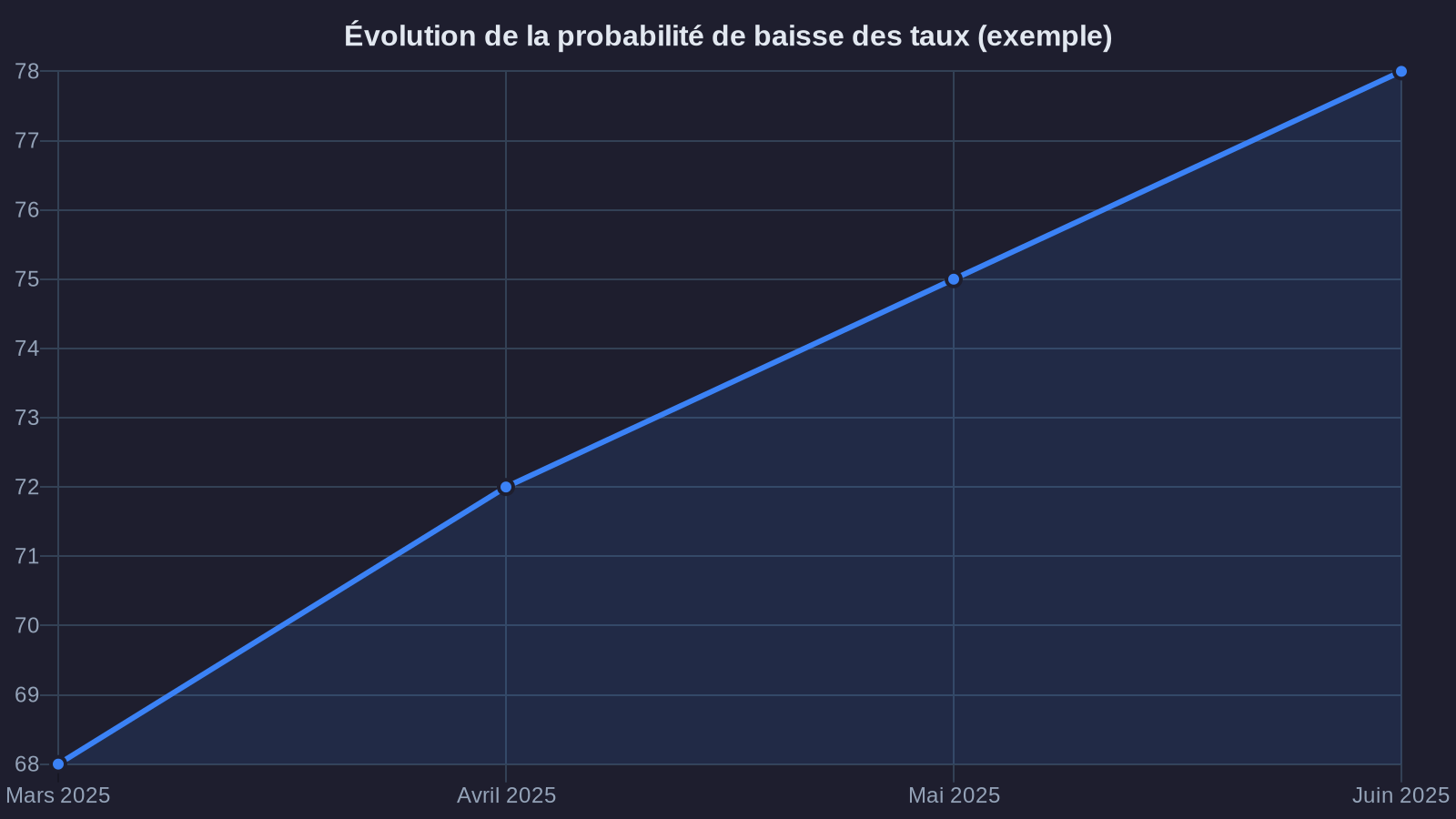
Let's take a concrete example. In March 2025, a contract stating "The Fed will cut its rates by at least 0.50 points before the end of June" trades at 0.68 dollars. This means the market estimates the probability of such a decision at 68%. If you believe this probability is underestimated, you buy the contract. If the Fed does indeed cut rates by 0.50 points or more, you cash in 1 dollar, a gain of 32 cents per contract (47% return). If it doesn't, you lose your stake.
This mechanism is nothing new. Nineteenth-century agricultural futures markets already operated on this principle of derivative trading. But until recently, American regulators considered that political or societal events could not be the subject of derivative contracts, on the grounds that they constituted "gaming" (gambling) rather than hedging or investment instruments.
The historical precedent of Iowa Electronic Markets
Yet there is a precedent dating back more than thirty years. Since 1988, the University of Iowa has managed a prediction market on U.S. presidential elections, with the tacit consent of the CFTC. But this market remains confined to an academic setting, with amounts limited to 500 dollars per participant. Kalshi, on the other hand, targets a mass market, with potentially significant volumes.
This ambition changes everything. When millions of dollars exchange hands daily on the outcome of a vote or court decision, the question of market manipulation becomes central. And that is precisely the argument the CFTC advanced to block Kalshi's election contracts.
Market manipulation or information aggregation? The debate over prediction market regulation
The CFTC fears two types of risks linked to market manipulation. First scenario: influential actors (election campaigns, lobbies, media) could massively buy contracts to artificially create the impression that a candidate or outcome is favored, thus influencing public opinion and, ultimately, the actual election result. This is the feared feedback loop: the market would no longer merely predict the event, it would cause it.
Second scenario: insiders with non-public information (internal polls, mobilization data) would take massive positions in these markets, creating an information asymmetry comparable to insider trading in stocks. Unlike stock markets, where companies publish quarterly reports, a political event has no "mandatory transparency."
The argument for information decoupling
Kalshi and its defenders counter that these risks are theoretical and that, in practice, prediction markets often prove more reliable than opinion polls. Several academic studies have shown that prices on these markets effectively aggregate dispersed information: one trader may have read a local article about voter mobilization in a specific county, another has an intuition about demographic dynamics, a third has noticed a shift in media tone.
This decentralized aggregation produces a "wisdom of crowds" that often surpasses centralized models. In 2020, prediction markets better anticipated Biden's victory in several key states than polling institutes. They also correctly assessed the probability of prolonged legal challenges to the result.
But this argument doesn't fully address regulatory concerns. For if a market aggregates information well, it also becomes a prime target for those wanting to influence perceptions. Buying 10 million dollars worth of contracts for "Candidate X's victory" costs less than a national advertising campaign, and the psychological effect (the market favors him) can be considerable.
Implications for alternative yield products
Beyond the political dimension, this legal battle has direct repercussions on the world of alternative investments. If Kalshi wins decisively and durably, it validates the existence of a new asset class: contracts on discrete non-financial events.
Concretely, this means that soon we could trade contracts on court decisions, regulatory approvals (for example, FDA approval of a drug), or non-monetary macroeconomic events (IPCC report publication, sovereign rating revisions).
Uncorrelated returns and wealth diversification
For a wealth-building investor, the interest lies in decoupling. Equity, bond, and even real estate markets share common risk factors (interest rates, growth, inflation). Contracts on discrete events, however, respond to their own dynamics. A Supreme Court decision on an environmental issue can cause these contracts to fluctuate independently of S&P 500 levels.
Let's take a concrete simulation. Suppose you allocated 5% of your portfolio (10,000 € out of 200,000 € in financial assets) to a diversified prediction market strategy. You distribute these 10,000 € across ten different contracts: three contracts linked to central bank monetary decisions, three contracts on pharmaceutical clinical trial outcomes, two contracts on judicial decisions, and two contracts on geopolitical events.
Historically, well-managed prediction markets display average annual returns of 12 to 18%, with high short-term volatility but low correlation with stock indices (correlation coefficient below 0.3). Over three years, this allocation could generate between 1,500 and 2,500 € in gains, while reducing overall portfolio volatility through decoupling.
Specific risks to consider
This asset class nonetheless carries risks specific to it. First point of caution: liquidity. Unlike CAC 40 stocks, a contract on a less-followed event can see trading volumes collapse as the expiration date approaches, making it difficult to exit positions. It is therefore essential to prioritize contracts on widely publicized events, with an active order book.
Second risk: information asymmetry. On certain events (regulatory decisions, clinical trials), some actors have privileged information. Unlike stock markets where insider trading is firmly punished, prediction markets operate in a still-murky legal framework. A retail investor potentially faces better-informed counterparties.
Third point: regulatory risk, precisely illustrated by the Kalshi affair and the trading restrictions imposed by the CFTC. If the CFTC decides tomorrow to ban certain categories of contracts, existing positions could be liquidated under unfavorable conditions. This risk of administrative closure is specific to emerging assets, not yet stabilized in the regulatory landscape.
What this means for your wealth
The outcome of the Kalshi case goes beyond a simple regulatory quarrel. It raises the question of the boundary between financial innovation and public protection. If prediction markets develop within a regulated framework, they will offer wealth-building investors a source of complementary returns, particularly interesting in an environment where real rates remain low and where correlation between traditional assets tends to increase during periods of stress.
For now, access to these markets remains limited. Kalshi operates under a U.S. license, with geographic restrictions. Other platforms, like Polymarket, operate outside the regulated framework, on decentralized blockchain infrastructure, but without the prudential oversight guarantee that CFTC approval provides. This diversification of approaches echoes the transformations also occurring in the DeFi sector with yield-bearing stablecoins.
The most likely scenario for the next three to five years? A coexistence of regulated platforms (Kalshi, potentially other players if jurisprudence confirms the trend) and unregulated decentralized markets. Investors will need to trade off between legal certainty and accessibility. For thoughtful wealth allocation, regulated platforms offer a more reassuring framework, even if opportunities are currently more limited.
What this legal battle reveals most of all is the speed at which the financial landscape is transforming. Products considered marginal a decade ago are gradually becoming legitimate investment tools. Staying alert to these developments is not opportunistic speculation: it is a coherent wealth diversification approach, provided you master the specific risks and devote a reasonable portion of your overall allocation to them.