On January 15, 2025, OKX announced the acquisition of a 20% stake in Coinone, one of South Korea's oldest crypto exchanges. This move goes far beyond a simple strategic investment. It reveals a sharp acceleration of market consolidation in Asian crypto, where global platforms are seeking to establish local footholds amid increasingly demanding regulatory frameworks.
South Korea represents a mature crypto market, with significant institutional adoption and one of the world's strictest regulatory frameworks since the Virtual Asset User Protection Act of 2023. In this context, it's simply not viable for a global exchange to make do with a generic online presence. Market access now hinges on solid local partnerships, or even direct equity stakes.
Strategic positioning in the South Korean market
Coinone is no emerging platform. Founded in 2014, it ranks among the four exchanges authorized to operate in South Korea following the major regulatory waves of 2021-2022. This license, obtained after months of audits and compliance work, represents a major strategic asset. The OKX-Coinone acquisition is not merely about technical infrastructure, but about regulatory access that would be difficult to replicate elsewhere.
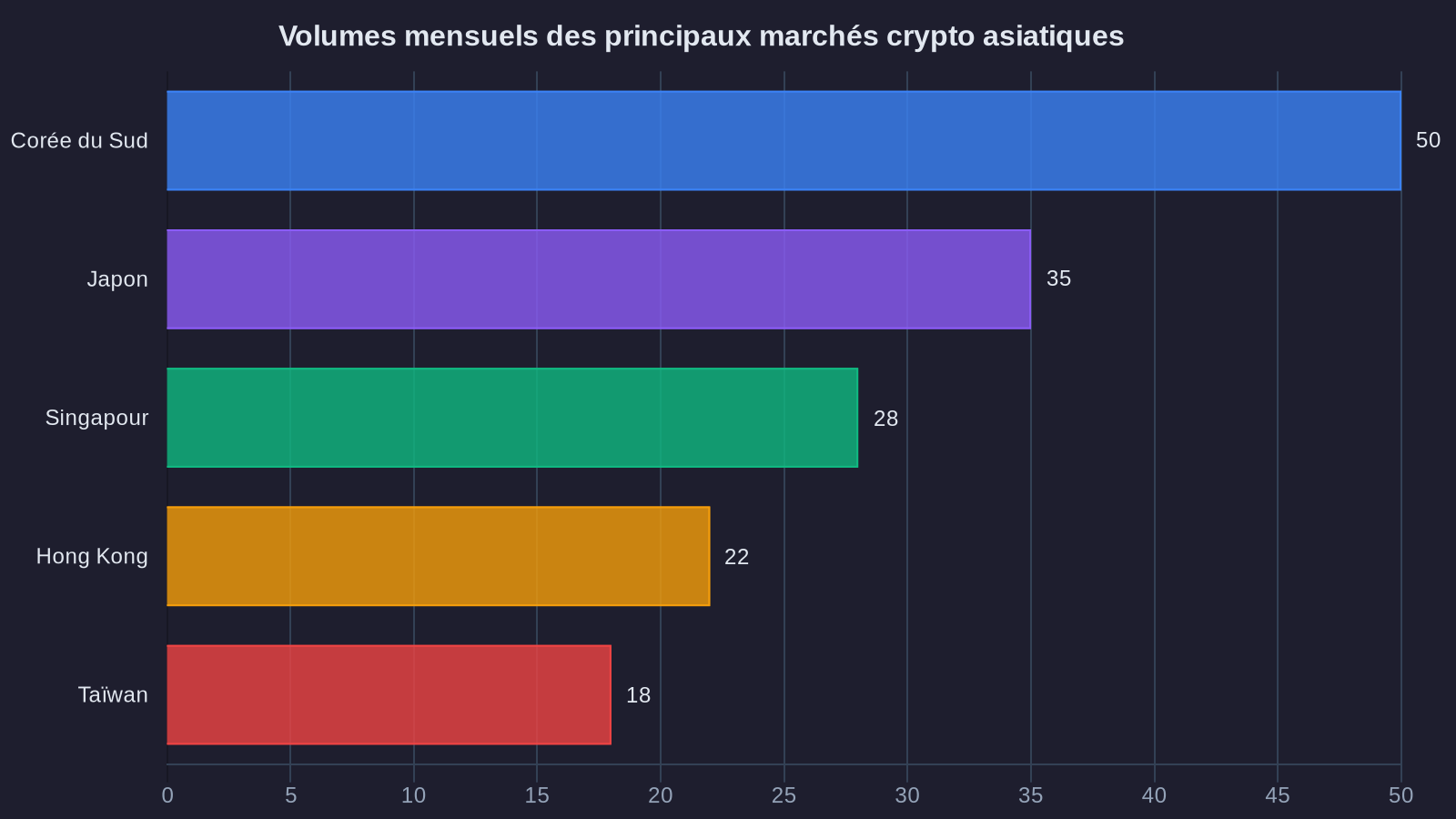
The numbers tell the story. The South Korean crypto market represents roughly $50 billion in monthly trading volumes, with an estimated user base of 6 million people. More importantly, Korean investors show a marked appetite for active trading, with turnover rates among the highest globally. This user profile is particularly attractive to a platform like OKX, historically positioned around derivatives and advanced trading.
The move also allows OKX to sidestep entry barriers imposed by South Korea's Financial Services Commission (FSC). Since 2022, new license applications are essentially frozen. Regulators favor close oversight of existing players rather than welcoming new entrants. In this environment, a stake in an already-licensed platform becomes the only realistic path to market access.
A broader trend in Asia's crypto ecosystem
This move is part of a larger dynamic of consolidation among Asian exchanges. Since 2023, there's been an acceleration of mergers, acquisitions, and strategic partnerships across the region. Binance strengthened its position in Japan through partnerships with local entities. Bybit is multiplying distribution agreements across Southeast Asia. Even Coinbase, historically focused on Western markets, is actively exploring opportunities in Asia-Pacific.
This consolidation responds to straightforward economics: compliance costs are skyrocketing. Maintaining a license in jurisdictions like South Korea, Japan, or Singapore requires massive investments in security infrastructure, compliance teams, and regulatory reporting. Mid-sized platforms struggle to absorb these costs while remaining competitive against global giants that benefit from considerable economies of scale.
Asian regulators, meanwhile, are implicitly encouraging consolidation. They prefer overseeing a handful of major players with solid technical and financial resources rather than managing countless small platforms that are difficult to control. The message is clear: either you reach a critical size that justifies the necessary regulatory investments, or you find a partner.
The South Korean market's unique characteristics
South Korea presents specificities that make this type of operation particularly relevant. The country imposes strict tax treatment on crypto gains (20% above 2.5 million won), with complete transaction traceability through the Real Name Account system. Every exchange account must be linked to a verified bank account issued by one of the four authorized partner banks.
This level of integration with the traditional banking system creates substantial entry barriers. A foreign exchange cannot simply launch services in South Korea hoping to sidestep these obligations. It must establish formal relationships with local banks, negotiate partnership agreements, and implement KYC systems compliant with Korean standards. A process that takes years and requires substantial local presence.
By taking a 20% stake in Coinone, OKX's expansion effectively inherits these banking connections, these proven compliance processes, and this intimate knowledge of the local market. It's a strategic accelerator that likely saves the company three to five years of organic development.
Implications for the broader ecosystem
Beyond the OKX-Coinone merger, this deal illustrates a structural shift in the exchange industry. The pure global platform model, operating uniformly across all markets, is reaching its limits. Major crypto jurisdictions now impose localization requirements so stringent that they force international players to build autonomous regional presences.
We're moving toward a hybrid model: globally recognized brands, but deployed through distinct local entities adapted to each market's regulatory specifics. A structure reminiscent of major international banking groups, with their national subsidiaries operating under local supervision while leveraging group-wide infrastructure.
This evolution redefines competitive criteria in the industry. Exchange platform size is no longer sufficient. You must also have local integration capabilities, established relationships with regulators and banks, and teams capable of navigating complex and often shifting legal environments. A context that could mirror the restructuring observed in the token secondary market, where consolidation separates viable players from struggling projects.
Impact on liquidity flows
The progressive integration between global exchanges and local platforms could transform liquidity dynamics across Asia. Historically, Asian crypto markets display significant price premiums versus Western markets, particularly in South Korea (the famous "kimchi premium"). These spreads reflect structural difficulties in arbitraging between markets, due to capital controls and regulatory frictions.
Partnerships like the one between OKX and Coinone could facilitate better liquidity integration while respecting local regulatory frameworks. Flows could circulate more efficiently between platforms within the same group, reducing market inefficiencies without compromising the traceability regulators demand.
This progressive market convergence would benefit institutional investors, for whom price gaps between jurisdictions represent a brake on large-scale crypto asset allocation. A more integrated Asian market, with tighter spreads and increased liquidity depth, would ease institutional capital inflows that remain largely absent from the region today.
Outlook for market participants
For mid-sized exchanges, the message is unambiguous: total independence becomes harder to maintain by the day. Fixed costs are rising, competition intensifying, margins compressing. In this context, three strategies are emerging.
Some platforms choose ultra-specialization. Rather than attempting to compete across all segments, they focus on specific niches: exotic derivatives trading, NFT markets, advanced staking services. A viable approach for players capable of creating genuine differentiation.
Others opt for strategic partnerships, as Coinone did with OKX. They preserve their brand and operational autonomy while benefiting from a global actor's resources: shared liquidity, technical infrastructure, regulatory expertise. A hybrid model that maintains local anchorage while accessing capabilities impossible to develop alone.
Finally, some platforms accept outright acquisition. Faced with limited growth prospects and exponential regulatory requirements, selling to a major player becomes a rational exit. We should expect to see more of these deals in Southeast Asia and Latin America's secondary markets.
The regulatory factor will remain decisive
The evolution of the regulatory landscape will largely condition what happens next. If major Asian jurisdictions maintain high entry barriers while demanding substantial local presence, crypto exchange consolidation will mechanically continue. Global players will have no choice but to pursue acquisitions or partnerships to access these markets.
Conversely, regional regulatory harmonization, modeled on what the European Union is attempting with MiCA, could slow this dynamic. Common standards would facilitate the emergence of pan-Asian players capable of operating across multiple markets with a single structure. But this scenario seems distant for now, with Asian states clearly favoring regulatory sovereignty over regional coordination.
The OKX-Coinone agreement likely provides a glimpse of what awaits Asia's crypto industry in the coming years. The boundaries between global and local exchanges will continue to blur, giving way to hybrid structures combining international reach with local regulatory anchorage. A shift that could paradoxically strengthen ecosystem resilience by creating better-capitalized, more compliant players capable of weathering regulatory and market shocks — a lesson the DeFi industry learned the hard way when it comes to security and governance.